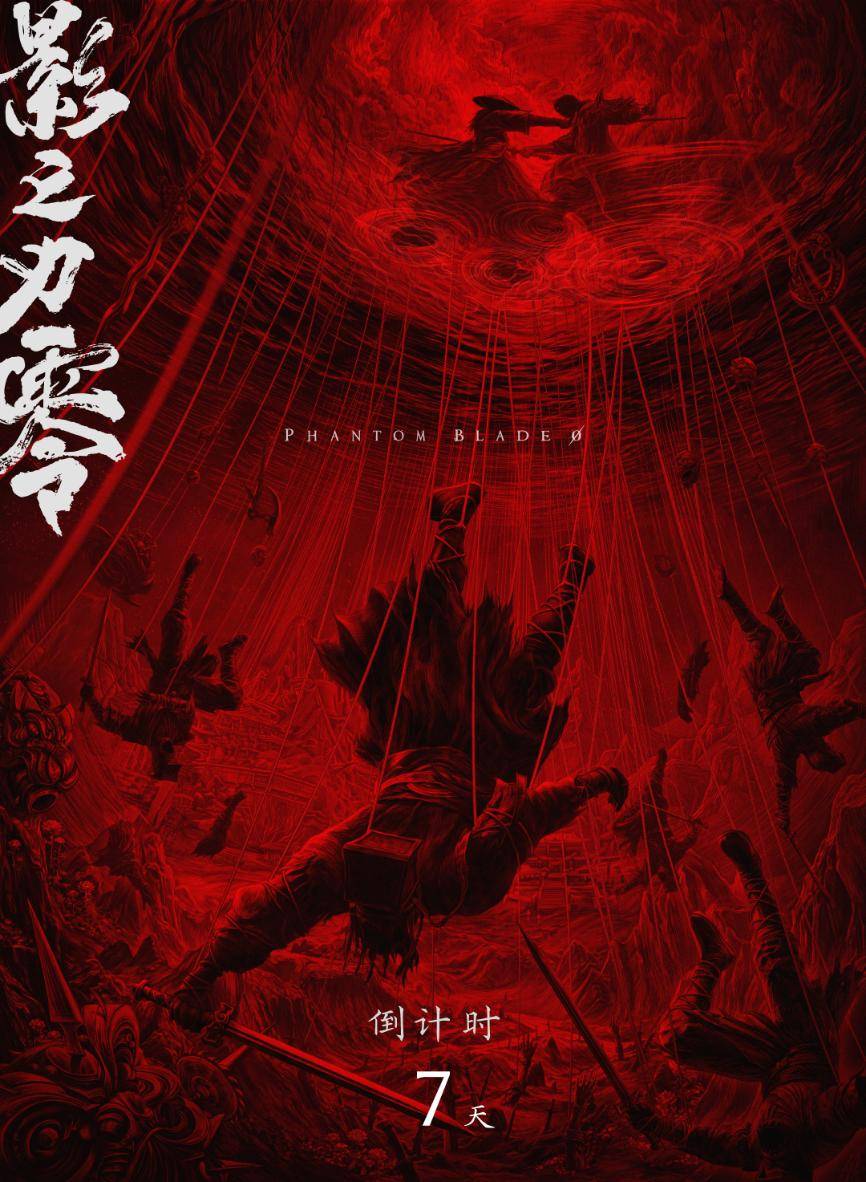
On October 22, the final launch trailer closed with a line confirming that a PS5 physical edition is coming in 2027. The high-resolution cover art for the Ultimate Edition's collector steel case followed, drawn by the film poster designer Huang Hai. A day later, the studio published a countdown art poster drawn by the same hand.
Seen separately, they are two pieces of marketing material. Seen together, they answer the question the steel case raises the moment it is announced: what exactly goes on the lid of the box.
Which edition this cover belongs to
According to the report relaying the Weibo post, the official account published the high-resolution artwork and announced that the game had entered its seven-day countdown, and the report describes the image as the work of "the renowned Chinese film poster designer Huang Hai."
The product it belongs to is the Ultimate Edition of the 2027 PS5 physical run. That run has three tiers — Standard, Deluxe and Ultimate — and the collector steel case is attached to the Ultimate Edition, the only one of the three for which an extra physical component has been named. The case itself does not arrive until 2027; the digital release on October 29 is a separate purchase.
The announcement itself is a single line in the trailer — "PS5 Physical Edition Coming in 2027" — with no accompanying press release and no price list for the three tiers.
In the version that was published, the game's Chinese and English titles sit along the bottom of the frame with a "seven days" countdown marker, which identifies it as promotional art released with the countdown rather than a photograph of the finished case.
One image, split into two planes
The palette is built on red and black. The upper half is sparse — a scene of rain. The lower half is dense — a scene of threads. There is no frame or dividing line between them: the ripples where rain pools on the ground sit exactly on the boundary, joining the rainy night above to the drop below.
Chinese coverage of the artwork likens this two-layer structure to the game's concept of "the Wulin and the Discordance" — the surface world and its underside. The comparison is the report's own; the studio did not define the relationship when it published the image. The phrase itself resolves into two separate nouns in the game's English text, the Wulin and the Discordance, so a single Chinese opposition arrives in English as two concepts standing side by side.
A steel case front is a narrow landscape format. This is a vertical composition, and nothing in the published material explains how it will be fitted to the box.
The upper plane: the duel in the rain
At the very top, raindrops strike the ground and gather into ripples. Two figures face each other in the rain: Soul and his closest friend, Zuo Shang. Their duel on that rainy night is where the story of the Phantom World's martial world begins, and it is one of the few passages in the artwork where a specific character can be identified by sight.
Its position matters. Read top to bottom, the image runs from origin to consequence. The beginning is placed at the top, and the further down the eye travels, the closer it gets to the things bound by red thread. The two men appear only here; the lower half belongs to weapons, masks and terrain.
The lower plane: weapons, masks, and an upside-down senior disciple
The bottom half is almost filled with threads. When the studio published the artwork it named the objects caught in them one by one: signature weapons from the game — Baimang Chilian, Zhuiming Suolian, Hupao, Xuedizi and Lieyan Shitou among them, none of which has an official English name — hung in the air or sunk into the earth; the masks of characters including Moyuan, the role played by Donnie Yen, and the Jade-Faced Lord, wrapped in red cord; and, at the visual centre, the senior disciple of the Seven Stars Sword Formation, hanging upside down. The weapon list in the original ends with "and so on," so more than the handful visible at a glance is caught in the web.
| Element | What the artwork shows | What it does in the frame |
|---|---|---|
| Rain | Ripples spreading where drops land, sitting on the seam between the halves | Marks the opening duel |
| Red thread | A web covering the lower plane, holding every object in place | The studio says it "echoes key plot points" |
| Weapons | Multiple named signature arms, suspended or buried | Placed by identity, not by owner |
| Masks | Moyuan's and the Jade-Faced Lord's, bound in cord | Hung on the same line as the characters |
| Senior disciple | The Seven Stars Sword Formation's senior disciple, upside down at centre | The visual anchor of the lower half |
Putting those objects side by side makes the editorial choice visible. What hangs in the web is not a full-body portrait of the hero but identity: a weapon stands for how a character fights, a mask for the face that character keeps hidden, and the inverted posture for where that character ends up in the story. The studio's explanation of the threads runs to a single clause — they "echo key plot points" — and which ones the game will have to answer.
This is also the densest part of the image. A game cover usually carries one focal point. Here several weapons, at least two masks and a human figure share the same frame, and the composition holds together only because of the thread: it turns a scatter of objects into a reading path, so the eye is not stopped by any single blade on the way down.
The two halves also run in opposite directions where people are concerned. The upper plane holds two figures standing apart and facing each other, their weight pressed into the centre of the frame; the lower plane holds a single figure, the senior disciple, inverted at the centre, with everything else hanging from threads. Travelling down the image, the number of people falls from two to one while the number of objects climbs from two or three to more than a dozen.
The bottom of the frame: Memory Flowers and the souls of the martial world
Along the lowest strip of landscape, a tower stands in the distance — the Tower of Killing Intent — with bodies scattered across the ground, blades driven into the earth, and Memory Flowers blooming among the dead. The studio's description is that this layer carries "the memories and souls of everyone in the martial world."
Memory Flowers is a fixed term in the game's vocabulary, tied to the sixty-six-day premise that runs through the story. Placing them at the very bottom of the composition sets the direction of gravity for everything above: however busy the two upper planes become, the image ends here.
Huang Hai, a poster designer who works in minimal Eastern imagery
Huang Hai founded the studio Zhuye Culture. His work is known for telling a story through minimal Eastern imagery, and he has won the best-poster recognition handed out by the British magazine Little White Lies. His film work includes posters for The Sun Also Rises, Let the Bullets Fly, Dying to Survive, Big Fish & Begonia and Shadow, and Chinese media routinely introduce him as the country's leading film poster designer.
Most of that work is subtraction: one face, one silhouette, one empty space, compressing a two-hour film into a single symbol. This commission is different in kind — a box cover that has to be recognised on a shelf, carrying the whole world of the game rather than a single mood.
The countdown poster: the same hand, a second drawing
On October 23 the studio published another art poster drawn by Huang Hai, this one for the six-day mark, with a four-line verse: "Life hangs on sixty-six; the body sits in a trap without interval. Sword in hand, cut the long dark; ask this heart before the martial world."
Sixty-six is not a figure of speech. Soul's heart is damaged and he has sixty-six days left, the constraint the whole game is built around. The verse puts the number in its first line, which is as close as a poster gets to a thesis statement.
The division of labour between the two images is clean. The steel case cover has to hold the whole Phantom World: two planes, a dozen weapons and props. The countdown poster tells one thing — how much time one man has left. Same hand, opposite methods. The release rhythm follows the countdown itself: the cover art arrived at seven days, the art poster at six.
Getting the steel case means waiting for 2027
The collector steel case comes with the Ultimate Edition, and the physical run arrives in 2027. No month, no price and no pre-order window has been announced, and the virtual contents of the three tiers have not been itemised either.
The digital release is unaffected: it unlocks on October 29, with pre-download opening at 10:00 Beijing time on October 27, and the PS5 build weighs in at 134.857GB. By Push Square's reading, that already exceeds the capacity of a single Blu-ray disc, and whether the physical edition will use two discs or require an extra download has not been explained. The cover art is public; whether the game fits on the disc is still an open question.
For anyone planning to buy the Ultimate Edition, this image is the only thing confirmed so far. At a minimum it settles one point about the 2027 run: the box will not be wearing a screenshot.