The Pangzhen you will encounter in Phantom Blade Zero is more than a rainy location borrowing an old name: it reimagines the starting point of Rainblood's story. Recognizing the town, however, does not tell you who will betray whom or survive in the new game. What makes the earlier story worth understanding is how an escape becomes a series of traps, not a set of answers you can carry into the new adventure.
Pangzhen is returning, but its old walkthrough does not carry over
The official Return to Pangzhen reveal, published on August 18, 2025, identifies the town as a key location in Phantom Blade Zero. Its hand-drawn map has become a three-dimensional environment, with buildings informed by scans of several historic Chinese towns. That confirms the return of a location and its visual motifs, not identical shop layouts, quest order, or character encounters. Official Return to Pangzhen reveal
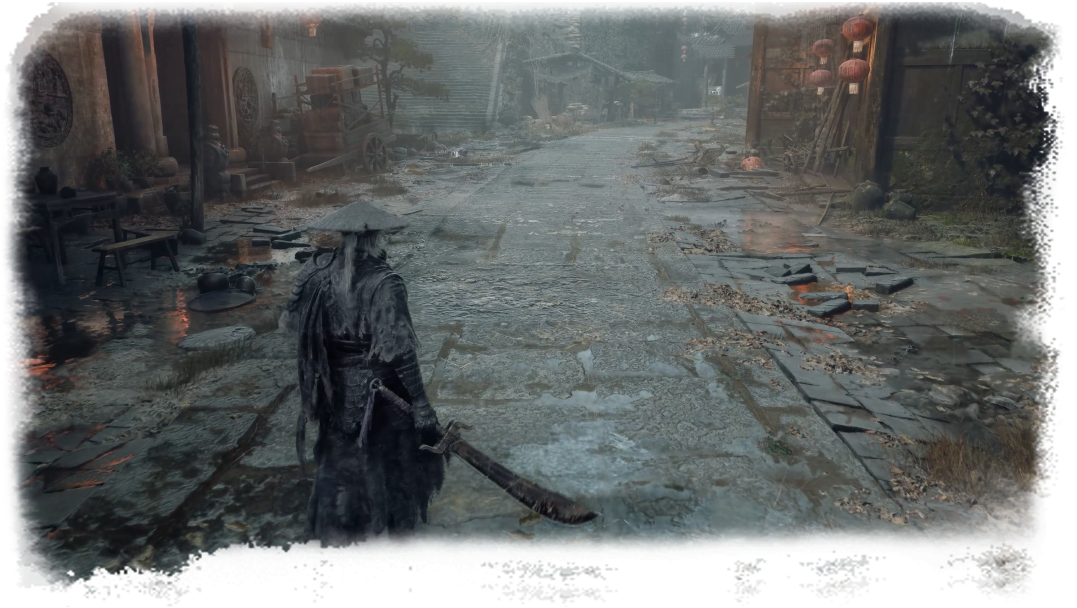
Phantom Blade Zero promotional image accompanying the August 2025 Return to Pangzhen gameplay reveal, not an original Rainblood map. Look for the stone street, wooden buildings, and lanterns; do not identify individual buildings as old quest locations. Source: official game website. © PARAWULIN PRODUCTION LIMITED.
If you want to preserve Rainblood's mystery, watch the official reveal instead of reading further. You do not need to finish the earlier games to understand Phantom Blade Zero. The developers have described a restructured story that new players can follow independently. Developer interview
Earlier-game spoiler warning: the following sections discuss deaths and major traps in Rainblood: Town of Death, plus the motive for the massacre revealed in Rainblood 2. To avoid those revelations, skip to “Which game should you revisit?” These events do not establish what will happen in Phantom Blade Zero.
Why Pangzhen became a town of death: separate two questions
When you follow Soul into the original Pangzhen, you arrive in a trading town that has already lost its vitality. A wealthy, badly wounded visitor previously stayed at Jingyang Xuan. After his departure, residents developed a mysterious illness, and even the survivors struggled to maintain ordinary lives. What initially resembles an epidemic leads you toward a human-made catastrophe.
Separate why the townspeople suffered from why Soul is being attacked. The first question concerns Shang's recovery. In the older story, his duel with Soul left him seriously injured too, and the Order sacrificed Pangzhen's inhabitants to produce a blood-based medicinal pill, Ningxue Dudan. The second question concerns the hunt for Soul. The catastrophe began before he entered town; it was not simply a stage assembled after his arrival to ambush the protagonist. The pill's item description in Rainblood 2 explicitly connects its creation to the massacre. Collected original item descriptions
That distinction also explains why the pharmacy matters. Medicine bought by Yu'er for her father initially appears to be a survival necessity in a sick town. Investigating it reveals an unusual ingredient connected to the Order, pointing Soul toward its Snake House outpost. This is not an unrelated side story interrupting the main plot. The illness, pursuing killers, and assassin organization gradually become parts of the same investigation.
When revisiting these scenes, separate clues about the massacre and medicine from clues about the attempt to kill Soul. You can then distinguish information explaining the town's catastrophe from bait intended to keep him following the trail.
Four people, four different positions
You do not need to memorize the Order's entire hierarchy first. The essential distinctions are who is being used, who is obeying orders, who has another agenda, and who will pay a personal price to help Soul.
| Character | Their place in the earlier story | Why it changes your interpretation |
|---|---|---|
| Yu'er | A girl buying medicine for her father, and a victim of the town's catastrophe | Her reappearance after death is not a resurrection; a familiar face can become bait |
| Lei Dang | Soul's old subordinate and friend, still serving the Order | Friendship and orders pull him in different directions; one encounter does not reveal his entire allegiance |
| Leng Tu | A pursuer who uses puppetry to exploit Yu'er's body | The person you see acting and the person controlling that action can be different |
| Baitouke | A recluse connected to old grudges in the martial world | He restores Soul's strength at the cost of his own life, passing on an unfinished obligation |
Yu'er's role is particularly important. Soul tries to help her and her father but cannot prevent her murder. After being buried, the girl apparently returns home; administering medicine then triggers an explosion. If you remember only a frightening girl, you miss the causal connection: the attackers exploit Soul's concern for a victim to bring danger close to him.
Baitouke shows you the opposite kind of exchange. What Soul expects to be help replenishing his fighting energy turns out to require the old man's remaining vitality. Baitouke wants Soul to avenge an old companion by killing An Chan. His assistance is therefore neither an ordinary shop purchase nor a gift without consequences. Soul gains the strength to continue while inheriting someone else's unfinished responsibility.
Revisit these encounters with two questions: what does this person want you to believe, and what have they actually sacrificed? The first helps expose Leng Tu's deception; the second explains Baitouke's choice. Neither requires forcing everyone into a simple, permanent category of ally or enemy.
Three traps exploit the people Soul wants to save
Pangzhen is dangerous not merely because it contains pursuers, but because Soul has reasons to approach the danger himself. The first trap involves the explosion after Yu'er's father takes medicine. The second hides lethal intent within Soul's meeting with Lei Dang at Jingyang Xuan. The third brings Soul, Lei Dang, and Leng Tu together at Duanhun Cliff for the final opportunity to strike.
Reading these as three fights misses their structure. The first exploits sympathy for Yu'er's family. The second uses the relationship between old friends. By the third, Soul is entangled in identifying a traitor, protecting his friend, and stopping Leng Tu. Each step gives him another reason to intervene instead of walking away.
The secret letter is not a reassuring final answer either. After learning that Leng Tu may be a traitor, Soul passes the letter and an associated object to Lei Dang as a warning. Yet that knowledge also exists within Shang's arrangements. You cannot assume that someone providing a true clue is not manipulating you. Information can be accurate while the action it encourages still benefits your opponent.
At the cliff, Leng Tu restrains Soul, leaving Lei Dang an opportunity to strike him. Lei Dang instead attacks Leng Tu and saves his friend, before eventually dying from poison. You can hold both truths together: he participated in the plot against Soul, and he ultimately rescued him. His rescue does not erase his earlier involvement; that involvement does not erase his final choice.
When watching the old sequence again, focus on who receives the letter, who decides to strike, and who changes the intended order. Those moments explain both how the trap works and why its outcome departs from the planner's intentions. Rainblood story recap, containing full earlier-game spoilers
Sixty-four days and sixty-six days are not one timeline
Different remaining lifespans do not necessarily indicate an error. In Rainblood's older story, Soul learns that he has sixty-four days after receiving the treatment that keeps him alive. Thirteen days pass before he enters Pangzhen, leaving fifty-one. Those figures describe two points within the same earlier narrative. Earlier-game chronology
Phantom Blade Zero presents a separate premise. You play Soul, accused of murdering the Order's patriarch and gravely wounded during the ensuing pursuit. Temporary treatment gives him sixty-six days to uncover the mastermind. That number belongs to the new game. It does not establish which day the old Pangzhen events occupy in the new story, or prove rules such as losing a day whenever you die. Official PlayStation story introduction
| What you can take from the older game | What it helps you understand | What it does not establish |
|---|---|---|
| The location called Pangzhen | A mystery emerging through streets, residents, and medicine | Identical routes, maps, or hidden-item locations in the new game |
| Soul's limited remaining life | His urgency and need for assistance | The new game's time penalties or exploration restrictions |
| The old fates of Lei Dang and Leng Tu | How the earlier story handles trust, orders, and betrayal | Identical identities or endings for similar-looking new characters |
The developers describe rebuilding the story around a retained broad framework, not transferring the original unchanged into three dimensions. You can look forward to recognizing familiar motifs while judging new relationships, quest requirements, and story decisions by what the new game actually presents. Developer discussion of the story's reconstruction
Which game should you revisit? Start with Town of Death for Pangzhen
If your main question is what happened to this town, choose a complete playthrough or story recap of Rainblood: Town of Death. Yu'er's family, the Snake House, Baitouke, and Duanhun Cliff all belong to that visit. You do not need to begin by memorizing centuries of world history.
If you want to follow the consequences beyond the town, continue with Rainblood 2. The medicinal pill connects Pangzhen's victims to the later struggle and makes clear that leaving town does not end the catastrophe's consequences. If you are more interested in why Soul and Shang once trusted each other, revisit the prequel Rain Blood Chronicles: Mirage, set during their shared missions. It is not an alternative version of the Pangzhen story. Earlier-game story order
If you only intend to play Phantom Blade Zero, none of these three games is compulsory homework. Watch the official Return to Pangzhen reveal and understand Soul's sixty-six-day predicament. To preserve the uncertainty of a first visit, avoid old ending compilations. To compare the stories, follow Town of Death with Rainblood 2, then treat the earlier characters' fates as points of comparison rather than answers to the new game.