In early October, a reporter from TheGamer toured S-Game's motion capture studio, guided by the game's combat director. The numbers that came out of the visit are blunt: for an action game with a campaign of roughly 30 hours, the team recorded more than 1,000 hours of motion capture. Every weapon in the game got a physical replica, and Soul's movements with each one were captured separately. A week later, Chinese outlet 17173 filled in the other half of the picture: what Donnie Yen and his stunt team actually did inside that studio.
Phantom Blade Zero is a wuxia action RPG from Beijing-based S-Game, due on PS5 and PC on October 29. Together, the reports answer one question: how do you shoot the motion for a game that sells itself on real kung fu?
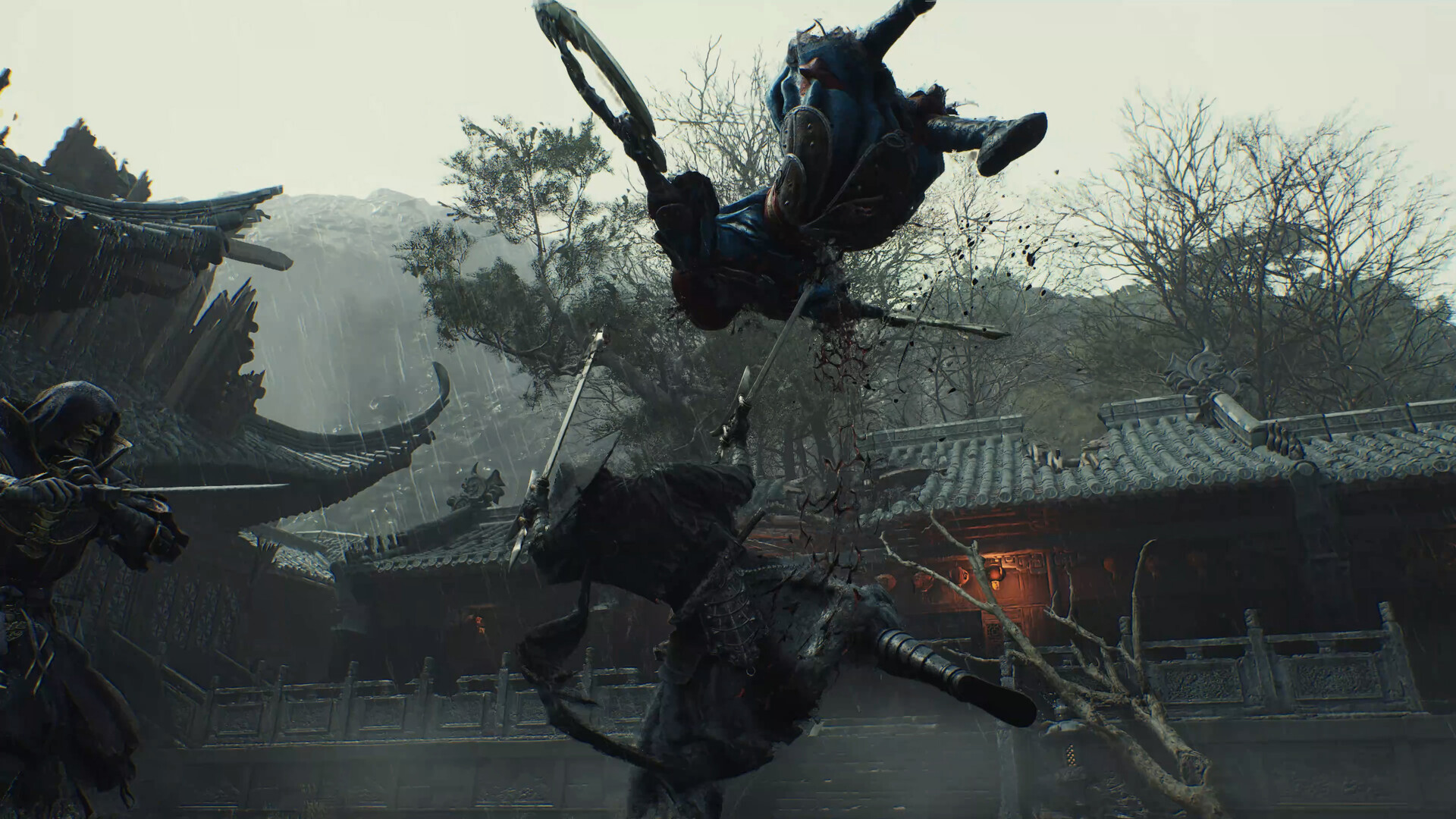
Inside the studio, cutscenes are shot like a kung fu film
The set TheGamer describes does not look like a typical game capture session. Actors wear tight black mocap suits and perform airborne flips on wires, with the camera blocking choreographed the way a martial arts film would stage it. According to 17173's account of the report, a single lapse in rhythm or posture sends the entire take back to the start, and anything short of clean meant starting over.
The working method, as 17173 put it in a second piece, is improvised on set, adjusted in real time, and recorded at full speed with real performers. Both 17173 and Gamersky relay the same reference point: the cutscenes are staged like a new Jackie Chan or Donnie Yen film. For a game, that comparison is about more than the difficulty of the stunts. It means the camera language, the cutting rhythm, and the performers' bodies are treated as one unit, so the sequence has to hold up the way a fight scene in a film holds up.
Cutscenes, though, are only one part of the job. The larger share of studio time goes to what players will see over and over: Soul moving with each individual weapon.
1,000 hours for a 30-hour game
TheGamer's comparison is stark. The campaign runs about 30 hours; the motion capture sessions ran past 1,000. S-Game has previously put the main story at 20 to 30 hours in interviews, so the low end of that estimate makes the ratio wider still. The way the team collected the footage explains where the time went.
The studio built a physical replica of every weapon. A sword, a spear, a hammer, and a soft sword do not move the same way, and the differences are not only in the silhouette. Size, weight, and the distribution of that weight change the arc of a swing, the rhythm of the follow-through, and how the character recovers. Because of that, the team did not capture one generic set of attacks and retune it per weapon. Each weapon's swings were recorded individually, with the prop in an actor's hands, and the report describes every single slash being captured that way.
By the official count given during the August showcase, the game has 30 main weapons and 25 secondary "Phantom Edges," 55 in total. The roster explains why one shared animation set would not have worked: alongside swords, twin swords, axes, spears, and hammers, it includes soft swords and drunken sword styles, which are built on completely different body mechanics. The design principle S-Game has stated is that every weapon carries its own mechanics rather than borrowing a shared base animation set, and the capture schedule is how that principle gets enforced.
17173 reports that each weapon took roughly a month of motion capture work. Multiplied across the roster, that alone would account for a large share of the schedule, but the report does not break the 1,000 hours down by category, so the total cannot be reconstructed from it. The month-per-weapon figure is 17173's account of what the development team told reporters; no itemized schedule has been published.
The alternative would have been cheaper. Animators can hand-key a swing, or retarget an existing clip onto a new weapon and adjust the timing. Both approaches are common in the industry. Capturing every weapon with its own prop gives up that economy in exchange for a performance that already contains the prop's real mass and reach.
Two kinds of capture in the 17173 report are easy to overlook. The first is gendered performance. Weapons exclusive to female bosses were recorded by female mocap actors, because the way a character generates power and the shape of the technique differ. When Soul later obtains the same weapon, the team did not simply reuse the boss's animation; separate performers were scheduled so that the moves matched the character using them. That distinction matters more than it might sound, because bosses drop their weapons: beating one lets Soul wield the same blade, so a single weapon has to work convincingly in two different bodies.
The second is group choreography. The game's seven-person sword formation required seven actors performing together in the same session, so that spacing and timing existed from the start. The lion dance boss brought in a lion dance master whose lineage the report describes as spanning more than ten generations, to guide the performance on set.
Both choices point at the same goal: the movement in the game should originate from someone who actually did it, rather than from a library of approximations stitched together later. Director Soulframe Liang has put the boss count at 50 or more, each with its own move set, which is the other half of the capture budget.
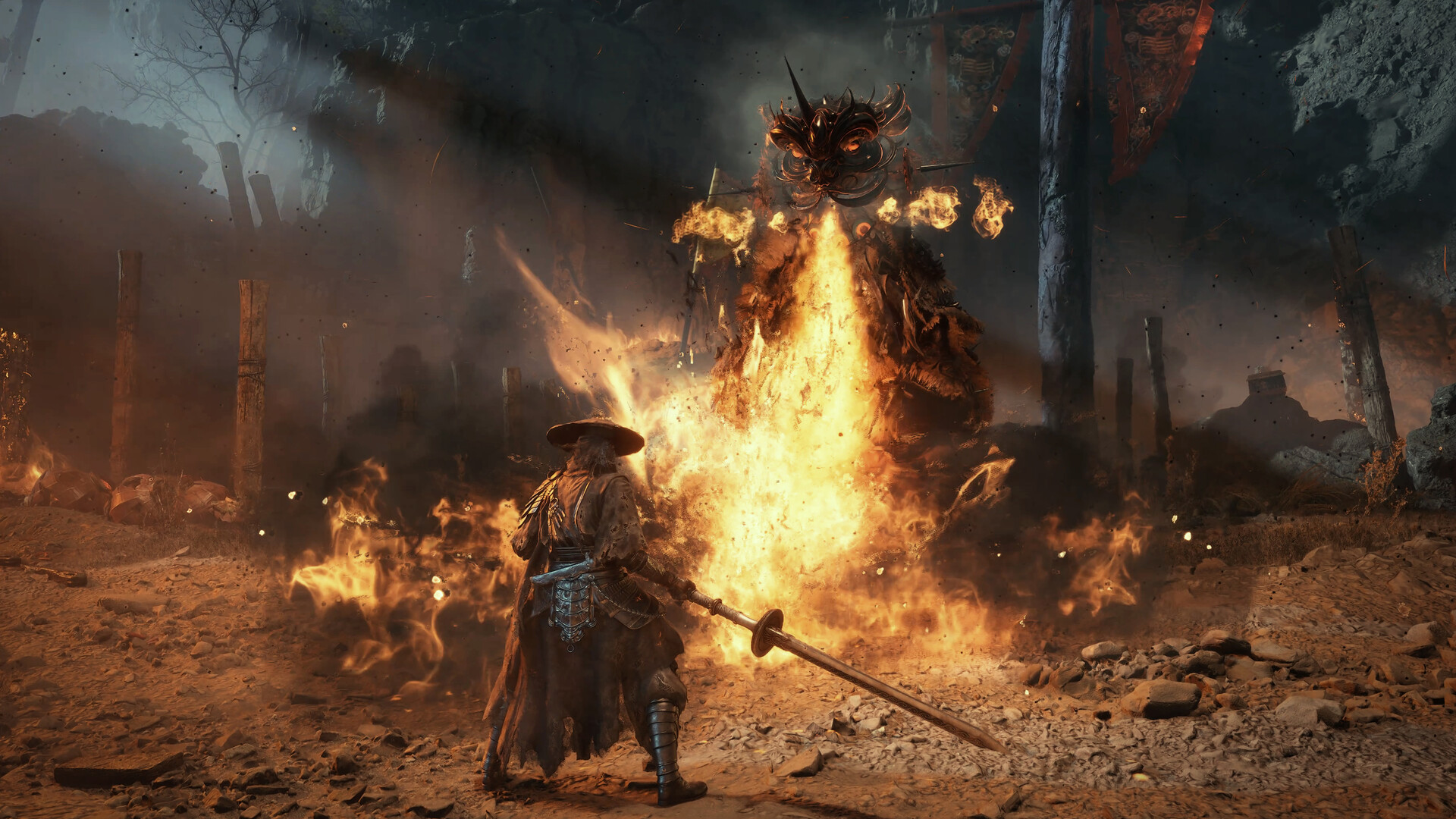
What Donnie Yen and his stunt team did in the studio
Donnie Yen plays Mo Yuan, Soul's father and the last lord of the Dark Demon Castle, an optional boss the official material describes as hidden behind a chain of exploration and trials. His involvement goes well past lending a face. He performed both the facial and full-body capture for Mo Yuan himself, and also worked on dialogue polish and expression direction.
On the title, the official wording is consistent: both the Steam announcement and the PlayStation Blog call him a creative consultant, and both date that role to 2023. 17173's report describes him as a producer. The character he plays arrived in stages. Mo Yuan appeared as a metal-masked figure holding a baby as far back as The Game Awards in December 2025, and the mask only came off at the end of the 11-minute trailer in August, when the game confirmed Yen as the face behind it.
17173 relays an interview published by Epic and describes the collaboration as co-creation across action philosophy and capture performance rather than a celebrity cameo. Liang is quoted saying that Yen contributed a large number of action ideas, settling not only the outward shape of techniques but also explaining the philosophy behind the kung fu and swordwork to the team.
The schedule tells its own story. Yen's film commitments were already full, yet he gave up a weekend to fly back from Europe on a Friday night, record in the studio, and fly out again on Sunday. The two teams also kept in regular contact through online meetings to confirm progress. His input reached specific scenes as well. The shot in the trailer where Mo Yuan holds a baby was originally designed more simply; Yen proposed reworking it and took part in the revision himself, which is how the version in the final trailer came to carry both tension and warmth.
He was not working alone. The overall design of the game's fight choreography was led by Kenji Tanigaki, the most senior member of Yen's stunt team, who designed and signed off on the action. Tanigaki's working relationship with that team goes back roughly three decades. Chen Hao, the Mandarin voice of the Ip Man series, handles the game's Chinese voice work, and veteran action director Yan Hua was brought in to choreograph the more difficult and complex fights. A Hong Kong action film crew, in other words, joined the production in the roles it would normally fill on a film set.
What all of this should look like in your hands
The scale of the capture work has to show up in two places: whether a weapon feels like it has weight, and whether an enemy feels like a different problem to solve.
The first is tied to how the loadout works. Soul carries two main weapons and two Phantom Edges at once, so switching happens during a fight rather than in a menu before one, which is where the weapon system and build choices meet. Phantom Edges cover tools other than melee weapons, from bowmen to wolves, so their animations differ in kind from a sword swing. Recording swings, blocks, and thrusts weapon by weapon is the precondition for that difference being visible on screen. A heavier weapon is not just a damage number with a slower animation attached; its arc, recovery, and combo rhythm should read differently from a lighter one, and the player has to register that inside a single combo.
The second shows up on the enemy side. Press who played the game in early October already met some of this content. Their reports described bosses with two phases and a death loop that restarts from the current phase rather than from the beginning — a design that depends on how readable a boss's opening move is.
The 1,000 hours measure input, not how polished the result is. The volume of footage shows how much work went into the action, but feel, hit detection, and whether weapons genuinely play differently can only be verified when the game launches on PS5 and PC on October 29. The things worth checking then are concrete: whether a heavy weapon's recovery frames really differ from a light one, whether a boss's tells are readable on a first attempt, and whether switching mid-combo feels like a decision rather than a menu action.