Phantom Blade Zero's combat setup is no longer a matter of trailer speculation. During its dedicated State of Play broadcast in August 2026, S-GAME confirmed that the protagonist Soul can wield 30 primary weapons and 25 secondary weapons called Phantom Edges, carrying two of each into combat at the same time. The same presentation laid out four difficulty tiers, ranging from a story-focused mode to Sixty-Six Days, a configuration that turns Soul's 66-day lifespan into a real countdown. On top of that, weapons can be upgraded and then reforged with a full refund of every invested material, so changing your build direction never strands your resources.
This article walks through what the weapon system actually does, which weapons answer which enemies, and how the four difficulty tiers differ. Phantom Blade Zero launches on October 29, 2026 for PS5 and PC (Steam and the Epic Games Store); in the US and select regions it arrives on October 28.
Where this information comes from
Every number in this article traces back to the dedicated Phantom Blade Zero State of Play that aired on August 17, 2026 (August 18 at 10:00 AM Beijing time). The roughly 20-minute presentation was written and presented by Soulframe Liang, the studio's founder and CEO, and covered the weapon and build system, the difficulty options, and the Wulin's side-quest structure; Liang previewed the broadcast's scope on the PlayStation Blog ahead of the show. PlayStation Blog The earlier loadout framework — two main weapons and two secondary weapons, plus two potions and two accessories, with no traditional character levels — came from Liang's interview after The Game Awards in December 2025, where the release date was first revealed. RPG Site interview The State of Play settled the final counts: 30 primary weapons and 25 Phantom Edges. Some store listings say "20+ unique Phantom Edges"; the presentation's figure of 25 is the more specific and more recent one.
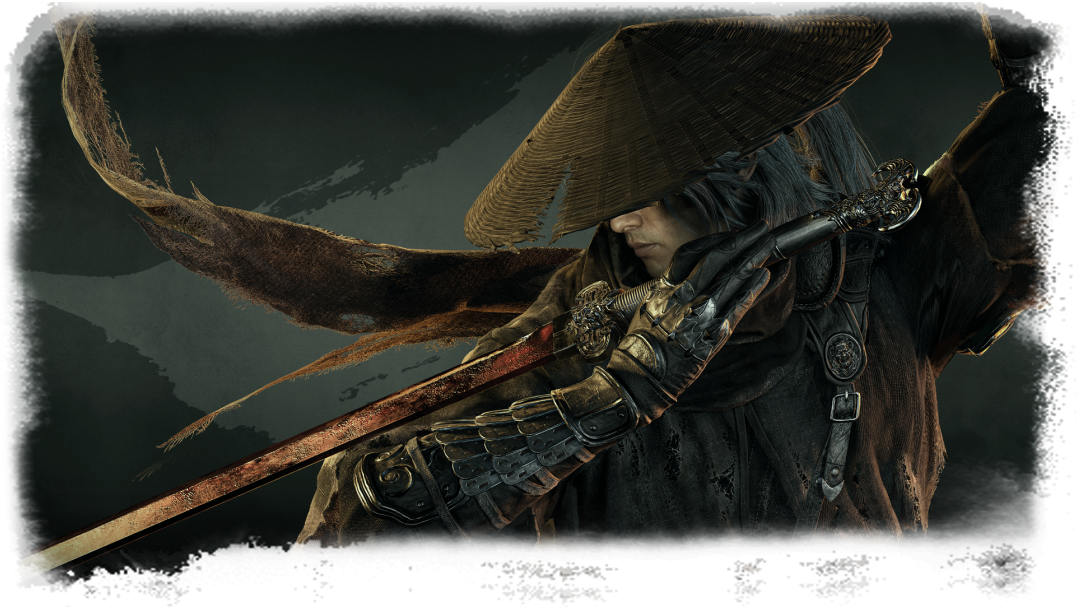
Phantom Blade Zero official key art from the game's website. Soul's signature weapon is a Chinese longsword, and the art shows the design language the weapon system is built on: traditional blades fused with mechanical fittings. Source: official game website; © PARAWULIN PRODUCTION LIMITED.
The primary weapons: 30 blades rooted in Chinese martial arts
The 30 primary weapons all draw from Chinese martial traditions — swords, twin blades, axes, lances, hammers, and more specialized arms such as flexible soft swords and a drunken sword set. The design philosophy behind them matters as much as the count. In the post-TGA interview, Liang explained that the weapons' prototypes come from real traditional Chinese weaponry, and that every weapon carries its own unique mechanics rather than sharing a common moveset template. The team deliberately avoided giving all weapons a shared basic kit, because shared fundamentals would flatten what makes each weapon distinct — both in how it controls and in how it looks on screen. RPG Site interview
That principle has a practical consequence for players: switching from a sword to a hammer is not a stat swap. It changes your combo routes, your timing windows, and the situations you are built to handle. Learning a weapon is a real investment, which is exactly why the refund system covered below exists.
Phantom Edges: the secondary layer
Phantom Edges are the 25 secondary weapons that hang off your main hand. Where primary weapons define your melee flow, Phantom Edges cover everything outside it: ranged pressure, status effects, and tools for controlling a fight before it closes to blade range. Footage from the presentation included handheld flamethrowers and cannons in this category — the kinds of tools that scatter formations, ignite explosives at a distance, or melt groups that would be awkward to fight one at a time.
A notable wrinkle: some Phantom Edges do not need to be hunted down at all. Defeat the enemy using one, and the weapon becomes yours. The arsenal grows through the fights you were going to have anyway.
The division of labor is easy to state. Your two primary weapons decide how the melee exchange goes; your two Phantom Edges decide what you can do about everything else — the archer on the roof, the pack circling behind you, the bomber running at your line.
The 2+2 loadout and how progression works
In combat you carry two primary weapons and two Phantom Edges. Together with two potions and two accessories, that makes the complete build Liang described — a kit you are expected to adjust for different bosses and elite enemies rather than a fixed load you carry from the first hour to the last. RPG Site interview
Three confirmed facts define how builds grow:
- Upgrading a weapon unlocks new forms and techniques that change how it actually plays in a fight.
- On top of the weapons, there is a skill tree. Souls have their own skill tree to develop alongside the weapon upgrade systems, so collecting materials and unlocking abilities is part of the core loop rather than a side chore.
- There is no traditional leveling. Liang is explicit about this: the team has no interest in a system where you hit level 100 for more HP or attack. S-GAME spent years building exactly that kind of numeric progression for its mobile games, and for Phantom Blade Zero they wanted each step of progression to empower the player with a new experience rather than a raw power-up. It is part of why he describes the game as a "Soulslite" — the level design and the progression are both tuned to stay legible instead of gating the world behind stat walls. RPG Site interview
For players, the upshot is that early material investments never become sunk costs, and enemy danger does not come from a level gap you can grind away. What you fight is roughly what you get.
Reforging: change direction without losing progress
Upgraded weapons are not permanent commitments. The presentation showed a reforge system — described in coverage as the Reforging Talisman — that resets a weapon's level and refunds all of the materials invested in it, letting you immediately reinvest everything into a different weapon or a different build path. There is no fee, no partial refund, and no penalty for experimentation. Presentation coverage
When a weapon no longer fits the enemies you are meeting, changing course costs a menu visit — the materials travel with you, and experimentation carries no penalty.
Match the weapon to the enemy
The State of Play devoted a segment to weapon matchups, and the core rule is blunt: light blades and thin swords lose to heavy shields. Lean on traditional blades alone and some fights become genuinely difficult. Against heavily shielded or armored enemies, the official guidance is to bring brute force — iron fists, heavy hammers, and other weapons that crack guards open rather than chip them. Coverage of the broadcast emphasized the same point: swapping your arsenal to match the enemy in front of you is a core skill, not an optional optimization. Inven Global report
The presentation also walked through several distinctive weapons, each built around one specific mechanic:
| Weapon | Mechanic | What it answers |
|---|---|---|
| Drunken sword | Builds a "drunkenness" state as you fight: Soul's steps stagger and sway, while his dodge ability rises sharply | Players willing to trade stability for evasive power |
| Twin blades (white serpent and crimson pair) | The two swords work as a set; the crimson blade can be hurled out as a ranged attack | Mid-range finishers and unexpected kills |
| Flexible soft sword | The pliant blade wraps around enemies to break their guard, and can cut through silk-thread attacks from the air | Guard-happy enemies and specific aerial threats |
| Hand cannon | One shot scatters distant enemy formations and can ignite self-destructing enemies before they close in | Ranged formations and bombers |
| Lion-head flamethrower | Sprays flame that reduces packs of enemies to ash | Clusters of hounds and other fast swarm enemies |
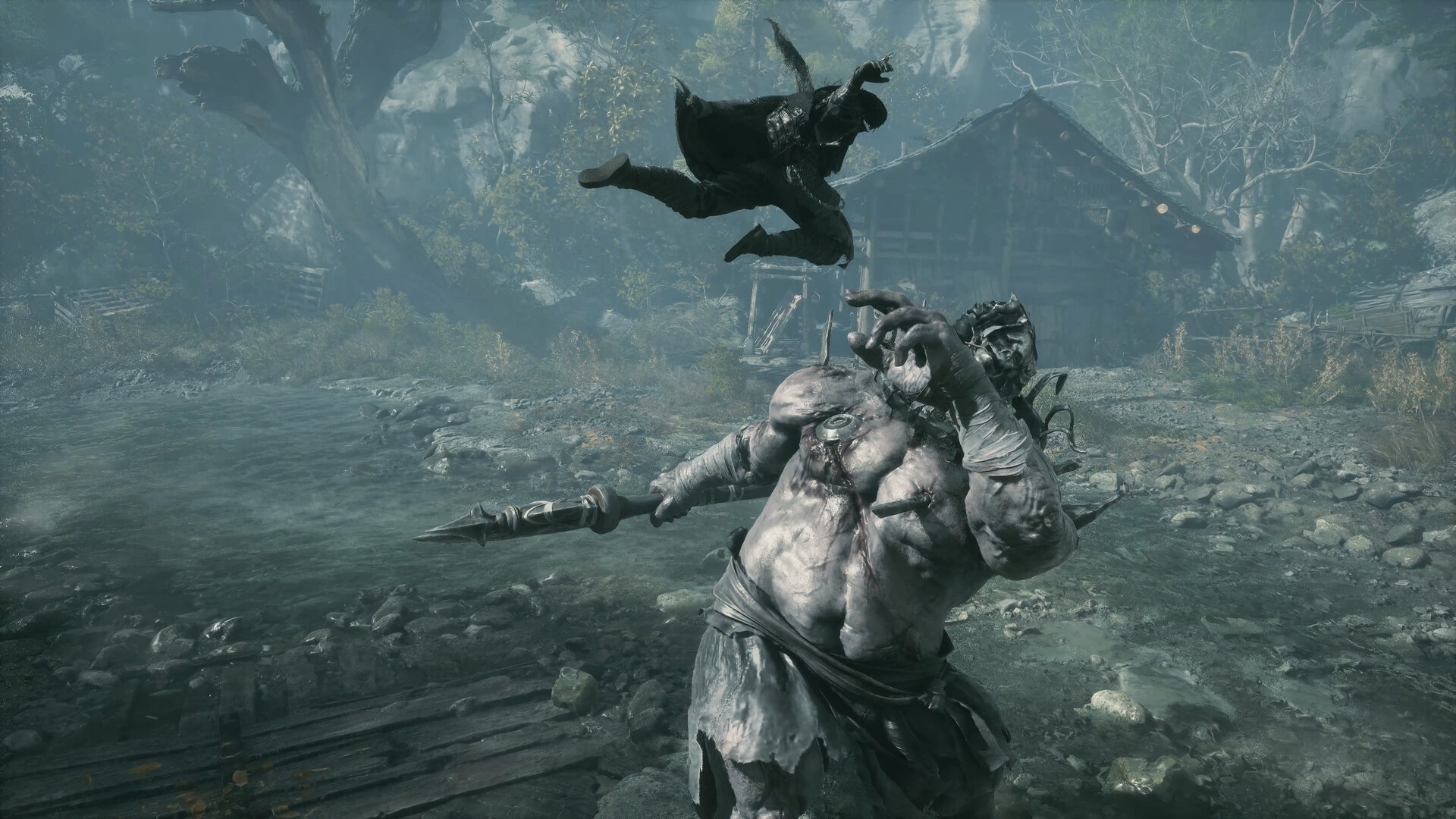
Phantom Blade Zero in-game screenshot from the Steam store page. Soul is airborne against an enemy many times his size carrying a polearm, with a weathered wooden cabin in the mist behind him. For opponents of this size and weight, the official guidance is to avoid grinding them down with light blades — a heavy weapon is the steadier answer. Source: Steam store page; © PARAWULIN PRODUCTION LIMITED.
Every weapon on this list answers one specific category of threat — the soft sword breaks guards, the cannon scatters formations, the lion-head clears hound packs. When a fight feels wrong, the intended first move is to check whether you brought the right tool, not to retry harder.
The four difficulty tiers
The State of Play confirmed four difficulty tiers, and one framing note comes first: per the presentation, the higher tiers do not work by simply giving enemies larger health bars and higher damage — enemy behavior itself becomes the challenge. If you have been wondering whether the game counts as a soulslike, the site has a dedicated article on that question; the official answer is effectively written in these four tiers.
| Tier | Positioning | What is known |
|---|---|---|
| Wayfarer | Story-focused, more forgiving | For players there primarily for the story and the world |
| Pathbreaker | Standard difficulty | The balanced combat experience the rest of the design assumes |
| Hellwalker | Hard | More advanced, adaptive enemy behavior |
| Sixty-Six Days | Special high-risk mode | Turns the story's 66-day lifespan into a rule: each death costs days, and zero means the end |
On the three regular tiers, Hellwalker is the one where enemies adjust in real time to the player's distance, missed attacks, and repeated habits — lean on one combo and they will punish it. Inven Global report
Sixty-Six Days: the story premise as a rule set
In the story, Soul is revived with exactly 66 days to live; Sixty-Six Days mode turns that premise into the mechanics. It is unlockable rather than available from the start — multiple reports state it opens after clearing the game on Pathbreaker or Hellwalker. Once active, you live under a 66-day countdown where every death costs one day, enemies hold Hellwalker-level strength, and reaching zero ends the run for good.
It is the only tier that truly punishes failure, and it is pointed squarely at second playthroughs: a run for players who already know the movesets and want all of that knowledge on the line at once. A first playthrough has no reason to touch it; a second playthrough finally has a use for everything you learned.
Which starting point fits you
- Here for the story and the world: Wayfarer. The tier exists precisely so the Wulin is not gated behind execution.
- Regular action-game experience, first playthrough: Pathbreaker. Standard difficulty is the baseline the whole combat design is tuned against; learn the defensive reads and weapon swaps there.
- Veteran worried about challenge: start on Pathbreaker, confirm the feel, then move to Hellwalker, where enemies read your habits.
- Second playthrough: Sixty-Six Days — 66 days, death costs a day, zero ends it.
On the weapon side, one piece of early advice covers most players: put your first upgrades into a heavy weapon you enjoy, so the shielded-enemy wall dissolves before it ever blocks a boss. And do not sweat the investment — the reforge refunds everything whenever your build direction changes.
For how the world itself is structured, see Is Phantom Blade Zero open world? How its eight maps actually work; for the story premise behind the 66 days, see Phantom Blade Zero story preview: Soul's 66-day journey.
This article is based on official game materials, the dedicated State of Play presentation, and reliable media coverage. Details may change with release or subsequent updates; the final game and official information take precedence.