Phantom Blade Zero's skill tree has eight nodes you cannot buy with levels. They sit between the three main upgrade lines, and the only currency that opens them is a Banyan's Heart. There are exactly eight of those in the game, and they come from two places: five human-faced banyan trees, one heart each, and three more sold by a single merchant.
That makes the trees hard to skip and easy to miss. None of them blocks the main story, and all five sit at the edges of their regions, which makes them some of the easiest objectives in the game to walk straight past.
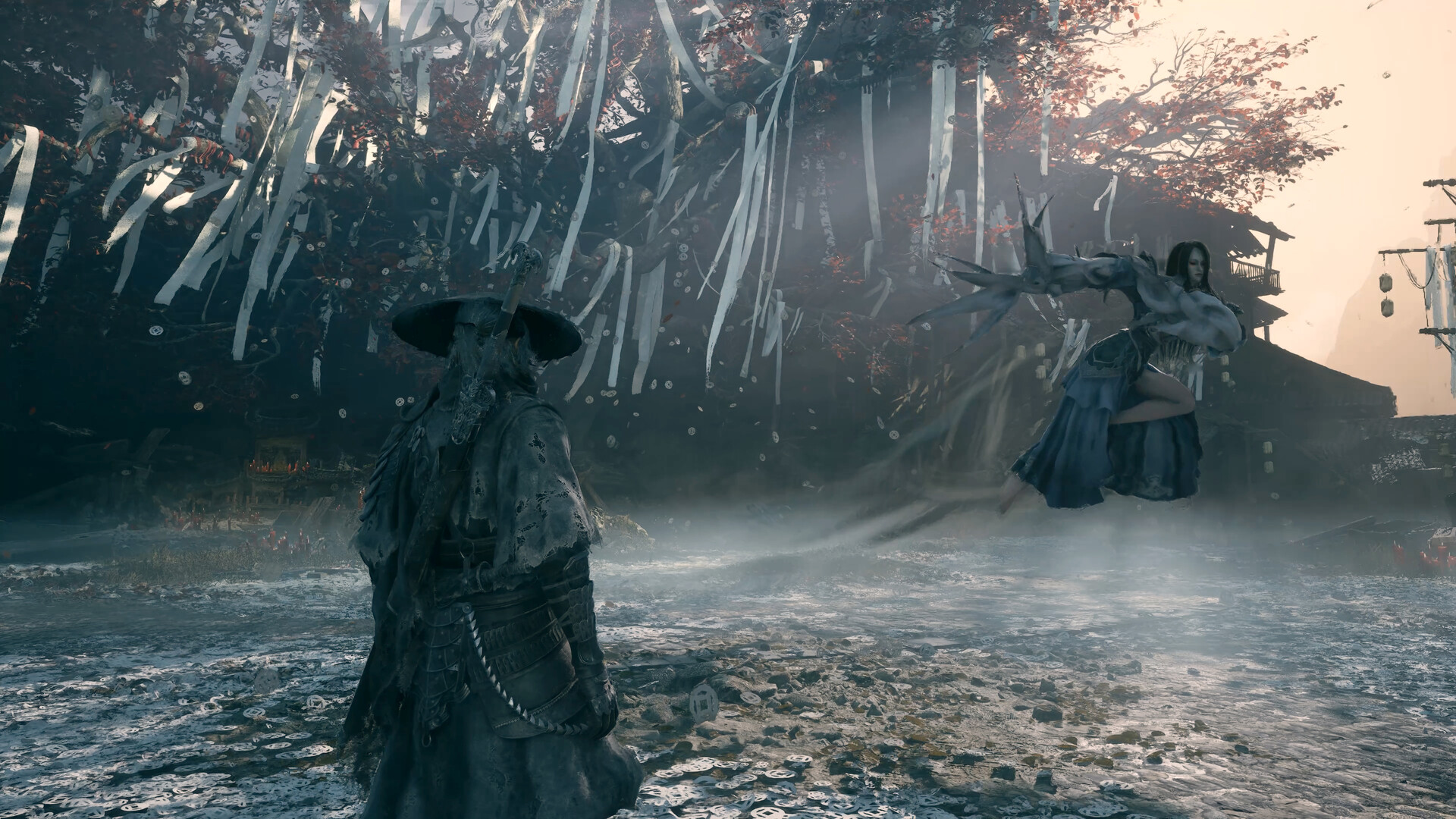
What a human-faced banyan tree is: a boss rematch you can retry
The five trees are spread across five regions, each one a huge old tree draped in white cloth strips. Touch it and the surroundings shift into a small arena, and the trial begins.
The structure never changes: two waves of ordinary enemies, then a boss. The boss is not a new face. It is a rematch against one you have already beaten in the main story, and in three of the five trials you fight two of them at once. GameSpot's guide calls these encounters rematches outright and notes that some of them put two opponents in the ring together.
Failure is cheap here. When Soul dies he respawns beside the tree, and progress resumes from the wave or the boss fight you were on rather than from the first wave of enemies. GameRant's write-up says the same thing from the other direction: the first attempt means clearing both waves, and every retry afterwards drops you straight into the part that killed you. The practical effect is a checkpointed practice run. The trash waves only have to be solved once; the fight you are actually stuck on is the only thing you repeat.
Clearing all five completes the mystery line named Heart of the Banyan and unlocks the trophy Chinese guide sites list as 草木也知愁. Those same guides fold the Banyan's Hearts into the game's ability training progression rather than treating them as a separate collectible.
Where the five trees are, region by region
The trees stand in the Crimson Forest, Pangzhen, the Mandate Encampment, Meigu Lake and the Mountain of Imprisonment. What they share is placement: each one sits beside a bell, the game's fast travel and save point. Activate that bell and you can teleport back for another attempt instead of walking the route again.
| Region | How to reach it | The trial's final opponent |
|---|---|---|
| Crimson Forest | The southern edge of the region. From the bell in the south, keep heading south until the tree appears at the map's border | Jing Ye, the Outlaw |
| Pangzhen | Push the main story to the bell by the hall in the middle of town, then look west | Master Bi Yuan of the Tianxuan Sect |
| Mandate Encampment | Enter with the Outer Gate Key, reach the bell on the Sunset Path, then ignore the road ahead and go right | Stone Hand Iron Fever and Iron Fiend, Young Mistress's Guardian |
| Meigu Lake | Once you have the boat, head east to the dock area on the lake's eastern side; the tree stands in the middle of the water | Cavalrybane, Elite Shadow Warrior and Soulclaimer, Elite Shadow Warden |
| Mountain of Imprisonment | Open the way with the Shrine Gate Key, then follow the path straight ahead | Jagged Steel, the Frenzied Brute and Iron Butcher, the Frenzied Brute |
The opponent names above come from English-language guide coverage and the game's English interface. No official Simplified Chinese names for these bosses have been published, so the originals are kept for cross-reference.
Three of the five locations are gated. The Mandate Encampment needs the Outer Gate Key, Meigu Lake needs the boat, and the Mountain of Imprisonment needs the Shrine Gate Key. None of those items exists for the banyan trees' sake — normal story progress hands them over — but it does mean three of the trees are unreachable until the campaign reaches the matching point. Crimson Forest and Pangzhen come first; in Pangzhen the tree is visible in the distance as soon as you head west from the hall. The Meigu Lake tree stands in open water, so the boat is not optional, and the Mountain of Imprisonment tree is the last of the five, by which point the Shrine Gate Key usually means the story is past its midpoint.
Bell placement matters more than it looks. Walking back is usually the tedious half of retrying a fight in this game, and every banyan tree deletes that half: the bell is close enough that a second attempt starts seconds after the death screen. Activating it also turns the tree into a fast travel anchor for its region, so clearing one early shortens the route through that map for the rest of the run.
The real difficulty spike is the three duo fights: Mandate Encampment, Meigu Lake and Mountain of Imprisonment. Two attack rhythms at once is a different problem from the one-on-one versions in the main story, and the margin for error is far smaller.
What a Banyan's Heart buys: eight nodes on rows two and four
The skill tree lives in the Train Abilities menu, which opens whenever you interact with a bell. That is also why every banyan tree stands next to one: finish a trial, walk a few steps, and spend the heart you just earned.
Three main lines run down the tree, fed by Blackstone, Sha-Chi Amber and Memory Flowers. Between them sit two extra rows — the second and the fourth — and those are the interconnected nodes. According to GameSpot, lighting one takes two conditions: the nodes it connects must already be unlocked, and you must have a Banyan's Heart in hand. It belongs to no main line, and no ordinary resource can substitute for it. Regular nodes on the main lines are paid for with the game's currency; interconnected nodes only accept hearts, and the two currencies do not convert.
GameSpot gives two examples of what sits in those slots. Boundless Capacity Lv. 3 opens an additional accessory slot. Against All Odds, once per battle, cancels a single attack that would drop your health below 10%. One is a permanent gain in equipment capacity, the other is a free escape from a mistake — neither is the "+5% damage" tier of upgrade.
The arithmetic is tidy: rows two and four hold eight interconnected nodes, and the game contains exactly eight Banyan's Hearts, one per node. Five come from the trees and three from the merchant, so a player who wants all eight slots lit cannot skip a single tree.
Unlike Blackstone Fragments, Sha-Chi Amber and Memory Flowers, the Banyan's Heart is a one-off. Four Blackstone Fragments combine into a single Blackstone that raises attack and posture damage, the other two materials accumulate by count, and all three can be gathered while playing. The eight hearts cannot: they have to be collected on purpose, and a region you have already left has to be crossed again.
The two conditions also explain why the hearts cannot be stockpiled and spent in one go. A node opens only when its neighbours are already lit, so the eight hearts have to be fed in along the branches rather than dumped into row two on arrival.
And the arithmetic cuts the other way too: skipping a tree caps a player at seven lit nodes even after buying out Zhang's entire stock of three.
The other three hearts are on Quick Hand Zhang's table
Quick Hand Zhang sells three Banyan's Hearts at 100,000 units of the game's currency apiece — English guide coverage refers to it as Remnant Dust. Buying all three costs 300,000.
Whether that is worth it depends on what you are missing. Anyone going for full completion should run the five trees first and top up with the three purchases afterwards. Anyone short of one specific node should check which two main lines that node bridges and whether the nodes on either side are already open before spending 100,000 on it, because the five hearts from the trees cost nothing but a fight.
Those purchases are also the fallback for a player who has finished the story and does not want to re-clear a duo fight just to open one slot. Currency is replaceable in a way that a missed tree is not, which is why the shop stock is best treated as the last three hearts rather than the first three.
Zhang also runs a treasure-hunting request of his own. Its locations and objectives are a separate thread with no prerequisite link to the banyan trials.
When to do them: follow the story, and come back if you are stuck
The order is decided by the campaign. Crimson Forest and Pangzhen are available first, then the Mandate Encampment, Meigu Lake and the Mountain of Imprisonment in sequence. Because the trees track the direction the story travels, going region by region is the same as going chapter by chapter. With a bell beside every tree, the workable habit is to clear the local tree whenever you arrive in a new region rather than planning a collection route later.
The reverse also holds: a duo fight that will not fall does not need to be ground out on the spot. The trial resumes from the last segment, so leaving to push the story, swap weapons, and raise levels and Phantom Edges before returning is a legitimate answer, and the enemy waves you already cleared stay cleared. Parking one is the cheapest option available. The duo trials in particular reward arriving late: the same two bosses that punish an under-levelled build at the intended point become a short fight once accessories and Phantom Edges have caught up.
This guide is based on coverage published on October 29 and 30, 2026, together with the game's English interface. If a later patch changes the trial structure, the trophy requirements or Zhang's price, the in-game display takes precedence.