On October 20, NVIDIA published GeForce Game Ready driver 621.01, and the headline on its announcement names Phantom Blade Zero alongside Call of Duty: Modern Warfare 4. For PC players, the driver version itself is the least interesting part. What the announcement confirms is that Phantom Blade Zero arrives with the complete DLSS 4.5 technology set and path tracing on day one. This article goes through the driver version, the three technologies, the generational GPU boundary, the launch-date time zones, and the pre-launch checklist, then lists what remains unpublished.
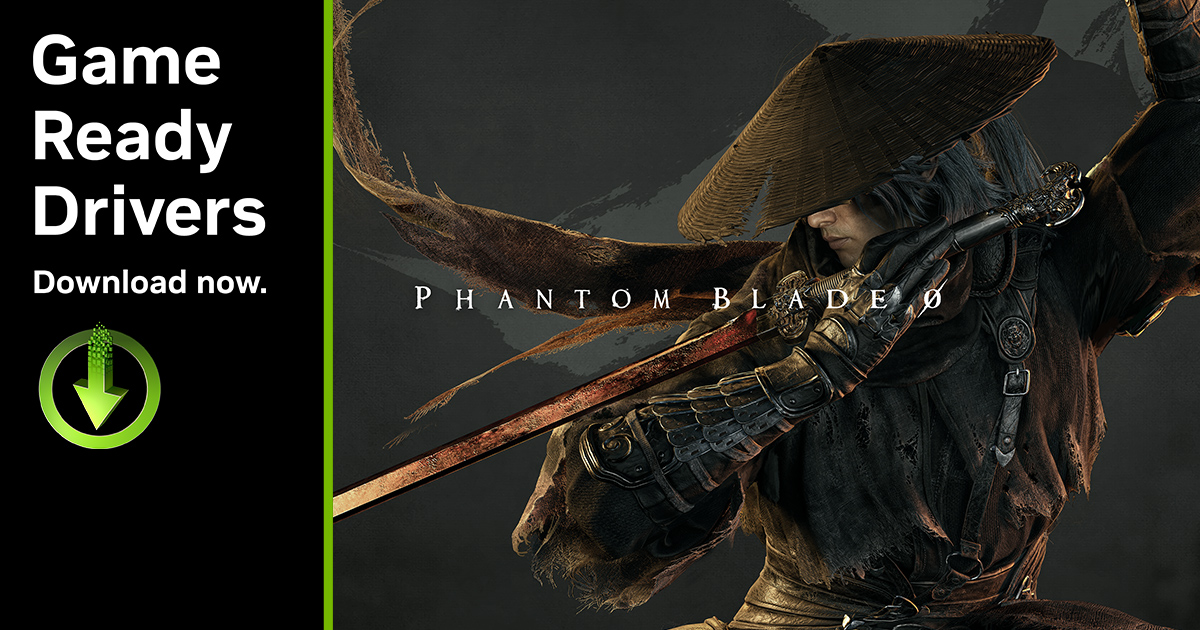
Driver 621.01: published October 20, eight days before launch
The driver was published on NVIDIA's GeForce news page under Andrew Burnes' byline, dated October 20, 2026. The announcement frames it as support for new games and updates, and Phantom Blade Zero is listed first.
NVIDIA's timeline is explicit: the game launches October 28 with the "full suite of DLSS 4.5 technologies" — the whole set, not one or two features picked out of it. The closing recommendation is equally direct: for the best possible experience when the game launches on October 28, download and install the new driver.
The driver is available through the NVIDIA app or NVIDIA's driver download page, both first-party routes. For Phantom Blade Zero specifically, 621.01 is the first driver release that carries Game Ready support for the game.
The three technologies shipping at launch
NVIDIA defines DLSS 4.5 on its DLSS technology page as the release that introduced Dynamic Multi Frame Generation and a second-generation transformer model for Super Resolution and Ray Reconstruction. Those three items, together with path tracing, make up the PC version's image-quality and performance stack.
DLSS Super Resolution renders at a lower internal resolution and reconstructs up to the display resolution. The second-generation transformer model is the change here; NVIDIA's framing is a model upgrade rather than a new toggle in a menu.
Dynamic Multi Frame Generation is the addition unique to DLSS 4.5. NVIDIA describes Multi Frame Generation as running on GeForce RTX 50 Series GPUs and fifth-generation Tensor Cores, generating up to five frames for every rendered frame. The "dynamic" qualifier is new in 4.5, and the technology page lists it as a capability without detailing how the multiplier shifts with load over time.
DLSS Ray Reconstruction handles denoising and the cleanup of ray-traced output. In the Phantom Blade Zero section, NVIDIA writes that the game's path-traced lighting and effects are refined and enhanced by DLSS Ray Reconstruction. That sentence is the key to reading the game's quality tiers correctly: path tracing decides how light is computed, Ray Reconstruction decides how clean the result looks.
The difference between path tracing and conventional ray tracing was already broken down from NVIDIA's published figures in this site's four-tier system requirements article. Conventional ray tracing casts rays for selected effects such as reflections and shadows; path tracing solves for a wider range of light behaviour across the scene. The cost is compute, and the payoff is lighting consistency. Phantom Blade Zero's path tracing is a launch option, not a post-release patch.
| Technology | Job | Hardware condition (NVIDIA's wording) | Status at launch |
|---|---|---|---|
| DLSS Super Resolution | Renders low, reconstructs high; 4.5 uses the second-generation transformer model | Not listed separately | Part of the suite |
| Dynamic Multi Frame Generation | Multi Frame Generation generates up to five frames per rendered frame; 4.5 adds the dynamic multiplier | RTX 50 Series plus fifth-generation Tensor Cores | Part of the suite |
| DLSS Ray Reconstruction | Denoises and refines path-traced output | Not listed separately | Part of the suite |
| Path tracing | Solves light behaviour across a wider range of the scene | Reference GPU is the RTX 5080 at 4K 60fps with upscaling | Launch option |
One name has to be kept apart from DLSS 4.5: DLSS 5 is a different rendering approach. NVIDIA describes it as using 3D-Guided Neural Rendering to infuse scenes with lifelike lighting and materials, tuned per game by its developers and supported on GeForce RTX 50 Series graphics cards and laptops. It is not part of the technology set shipping with this game, and it should not be folded into the same sentence as "4.5".
Which GPU unlocks which feature
The site's requirements article lays out NVIDIA's four tiers: GTX 1660 6GB or RX 5500 XT 8GB for 1080p at 30fps, RTX 3060 Ti 8GB or RX 6700 XT 12GB for 1440p at 60fps, RTX 5060 for ray tracing at 1080p 60fps, and RTX 5080 for path tracing at 4K 60fps. All four frame-rate targets are stated with upscaling enabled.
Layering the technology requirements over those tiers produces a few hard edges.
Multi Frame Generation requires the RTX 50 Series and fifth-generation Tensor Cores. The recommended tier's RTX 3060 Ti and RX 6700 XT therefore cannot use it; what they can use is Super Resolution and Ray Reconstruction, assuming the in-game menu exposes those switches. The ray-tracing tier's RTX 5060 is a 50 Series card, so the hardware condition is met, but NVIDIA's stated target for that tier is 1080p at 60fps with upscaling and does not say whether Multi Frame Generation is part of that figure.
The path-tracing tier is anchored to the RTX 5080 at 4K 60fps, again with upscaling. It is also the scenario where all three technologies stack most fully: path tracing produces the image, Ray Reconstruction denoises it, and Super Resolution plus Multi Frame Generation recover frame rate.
NVIDIA has not published a per-card support matrix for the individual DLSS 4.5 components. Which cards get dynamic multi-frame generation and which are limited to a fixed multiplier will only be settled once the in-game graphics menu and the NVIDIA app override list go live. At this point the one firm boundary is generational: the hardware condition for multi-frame generation is the RTX 50 Series and fifth-generation Tensor Cores, and whether 40 Series cards can enable it through the NVIDIA app's overrides is not addressed card by card.
October 28 or October 29: two time zones, one moment
NVIDIA's driver announcement dates the launch to October 28, while this site's earlier unlock-time breakdown records the PlayStation Store listing 02:00 UTC on October 29 and the Steam page showing October 28. The numbers do not conflict; they describe the same moment in different zones.
Converted to UTC+8, 02:00 UTC on October 29 is 10:00 in the morning of October 29; the same moment is 02:00 on October 29 in London and 03:00 in Berlin. NVIDIA writes announcements on its home dates, which is the usual convention in hardware-company posts.
For anyone planning to be there at unlock, the local time is what matters, not the date in the announcement. Preload and unlock are separate events: the PS5 download size of 134.86GB, with preload opening October 27, comes from a PSN data account rather than an S-GAME announcement. Once the preload is finished, the unlock no longer requires downloading the main package.
The rest of the same driver release
621.01 is not a Phantom Blade Zero exclusive; it covers several titles at once, and recognising that prevents a misreading.
Cyberpunk 2077's October 22 update adds DLSS 4.5 Dynamic Multi Frame Generation and upgrades its supported Multi Frame Generation, Ray Reconstruction, and Super Resolution to second-generation AI models. Call of Duty: Modern Warfare 4 launches October 23, and this driver adds Advanced Shader Delivery support for it, which NVIDIA describes as skipping shader compilation to get into the game faster. Crimson Desert Enhanced arrives October 29, also with the full DLSS 4.5 suite.
621.01 is a bundle release spanning several titles. For Phantom Blade Zero players there is exactly one reason to install it: the game's Game Ready support is written into this version, and NVIDIA puts "install this driver before launch" in the announcement itself.
The pre-launch checklist
Four items are settled. Everything else is still open.
Driver: install 621.01 from the NVIDIA app or NVIDIA's site. It is the only software step NVIDIA explicitly recommends before launch.
Preload: PS5 preload opens October 27 at 134.86GB. A separate PC preload schedule has not been announced.
Platforms and editions: NVIDIA's announcement lists Steam and the Epic Games Store as pre-order channels, with PS5 on the console side. Edition differences, including the price gap between the standard and digital deluxe releases and their pre-order bonuses, are compared item by item here.
DRM: the Steam store page lists Denuvo, and a separate article covers where that does and does not affect the game.
Nothing else has landed yet: the specific options in the graphics menu, whether a built-in benchmark exists, what the path-tracing tier actually demands from a CPU and memory, and the exact PC preload time. Those details usually arrive one or two days before launch, either from the publisher or from hands-on testing.
What is still unpublished
Separating what NVIDIA has said from what it has not saves a lot of guessing.
Stated: the full DLSS 4.5 suite is available on launch day, path tracing is a launch option, the driver version and its publication date are public, and the path-tracing tier has a reference GPU and a target.
Unstated: two items. First, the in-game graphics menu's tier structure and whether each technology has an independent toggle — no interface screenshots have been released. Second, whether the NVIDIA app's DLSS override feature applies to this title, which the announcement does not address.
Both share one property: they can only be settled once the game is in hand or the settings screen is published. Until then, any claim about how many frames a specific card will produce with a specific technology enabled lacks measured support — including projections for the RTX 5080 path-tracing tier. NVIDIA's 4K 60fps figure is a target, not a benchmark result.
How to use this checklist
For anyone who only wants to know what to do on launch day: install 621.01, wait for the preload, unlock at the local time. Three steps.
For anyone deciding how far their card can go: confirm the tier against the four official configurations first, then check the generation. The hardware condition for multi-frame generation is the RTX 50 Series and fifth-generation Tensor Cores; 30 Series cards do not meet that condition, whether 40 Series cards can enable it through the NVIDIA app overrides is not stated, and AMD cards run a different upscaling stack. Path tracing has exactly one official target, tied to the RTX 5080; every other card attempting it is outside NVIDIA's stated envelope.
For anyone asking what is actually new in DLSS 4.5: the new part is dynamic multi-frame generation, and the upgraded part is the second-generation transformer model. Both target specific jobs, adding frames and cleaning noise, rather than replacing how the scene is rendered. A genuine change in rendering approach is what DLSS 5 proposes, and this game's launch is not part of it.