In September 2026, PS5 Pro Enhanced was a single line of icon-labelled text in the compatibility block of the Phantom Blade Zero listing on the PlayStation Store. It confirmed that S-GAME was doing dedicated work for PS5 Pro and said nothing at all about what that work was. The game launched on October 29, Digital Foundry published its technical analysis the same day, and the three things the badge stands for can now be checked against measured results: two of them landed, one did not move.
This article does one thing — it takes Sony's official definition of the badge apart, clause by clause, and sets each clause against the post-launch findings. The numbers for each of the three graphics modes, and advice on which one to pick, belong to a separate piece: see our three-mode comparison.
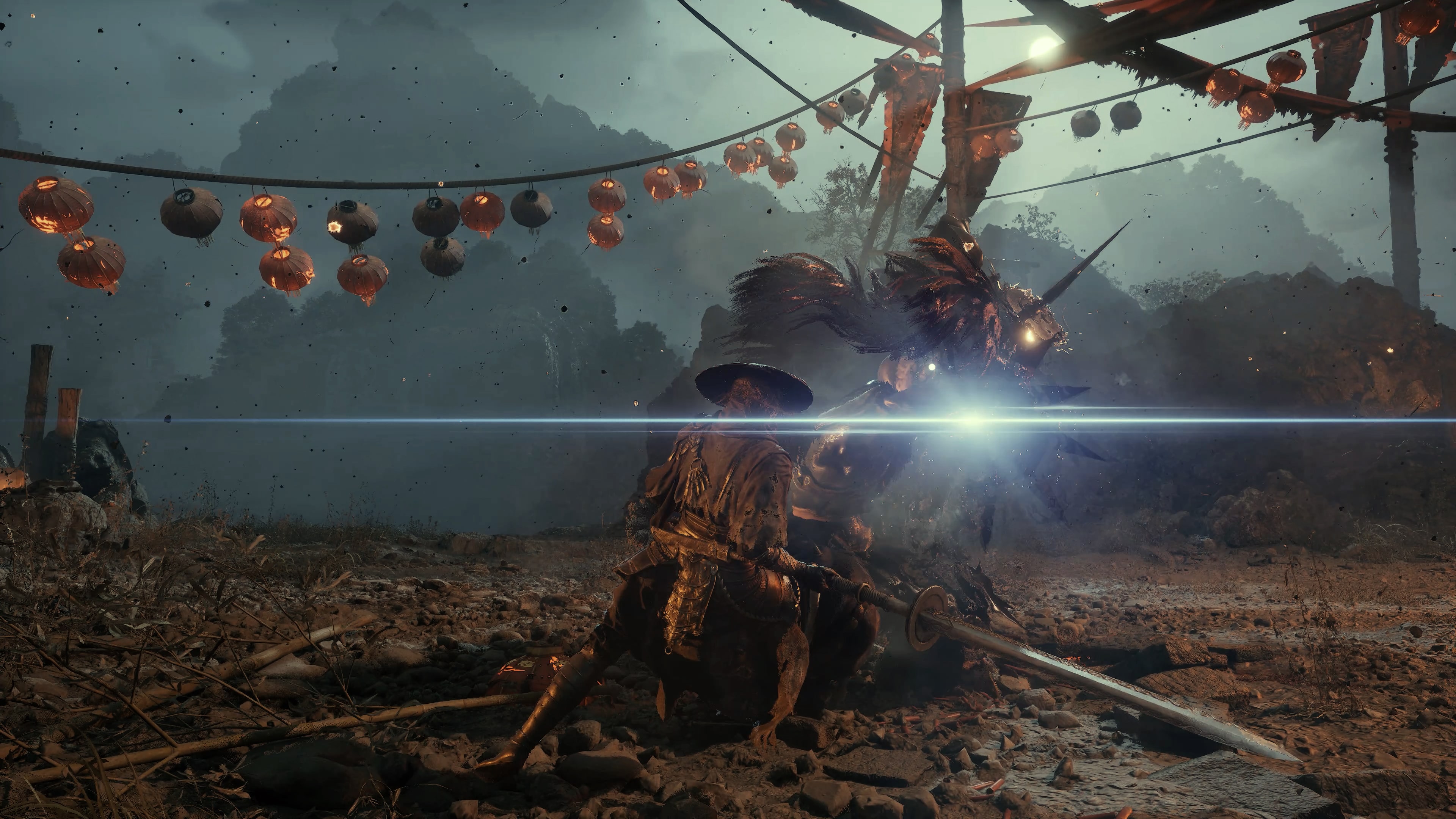
Official 4K screenshot from the Phantom Blade Zero page on the PlayStation Store (source: S-GAME / PlayStation Store).
What the badge itself says
The store notice is still there. It appears on the $59.99 Standard Edition page and the $69.99 Digital Deluxe Edition page alike, inside the compatibility information block, in the same column as DualSense vibration and trigger effects, Game Help, accessibility features, and a single-player player count. The badge is attached to the game, not to an edition: the store carries no separate "Pro" product to buy, and it does not split the game into two machine-specific listings — both consoles read from the same download and the same pre-order (edition contents and bonuses are compared item by item in our pre-order guide).
What that column can tell you is whether dedicated enhancement exists. It cannot tell you how far the enhancement goes. On its PS5 Pro pages, Sony attaches a qualifier to this whole category: enhanced features will vary by game. That sentence is the premise for everything below, because the same badge can mean a higher output resolution and nothing more, or it can mean scene lighting rebuilt around ray tracing.
The three things Sony wrote into the badge
Sony's description of PS5 Pro enhancement breaks into three parts. The first is advanced ray tracing: developers can use the console's additional power to bring reflections, shadows, and high-quality global illumination into their games. The second is PSSR, PlayStation Spectral Super Resolution, Sony's AI-enhanced upscaling technology, whose job is sharper image clarity on a 4K TV. The third is higher and more consistent frame rates.
The same pages confirm that the Pro supports both 60Hz and 120Hz displays — for the framerate side of the promise to show up in full, the display has to be running at the matching refresh rate. Separately, more than 100 games are now listed as enhanced on Sony's pages, which makes the badge a routine entry in an established ecosystem rather than a label invented for one title.
None of the three parts carries a number. There is no target resolution, no statement of ray tracing intensity, and no figure for how much the framerate rises. The badge promises a direction, not a magnitude. That is why delivery can only be judged after launch, from measurement — it cannot be read off the notice, however closely you look at it.
How the three promises landed
The technical analysis published on launch day settles each one:
| What Sony promised | What shipped | Verdict |
|---|---|---|
| Advanced ray tracing: reflections, shadows, global illumination | The Pro gains a ray tracing toggle covering shadows, reflections, and global illumination; the analysis believes it enables the hardware path of Lumen, with clearer geometric detail in reflections and a slight improvement to global illumination, but no meaningful change to shadows | Delivered |
| PSSR for a sharper image | The analysis believes the Pro uses PSSR in place of the TSR used on the base console, producing a sharper image in motion, most visibly in performance mode | Delivered, for image sharpness |
| Higher and more consistent frame rates | Pro frame rates remain broadly in line with the base PS5, down to the identical frame pacing problem in balanced mode | Not delivered |
Ray tracing is the most substantial of the three. With the toggle on, reflections show clearer geometric detail and global illumination improves slightly; on the shadow side the analysis found no meaningful change, so the toggle does not fix shadows along the way. A second finding matters just as much: enabling the extra ray tracing costs very little frame rate — almost none. That says two things at once. The Pro has hardware behind its ray tracing path, and the gain it produces sits in lighting quality rather than in smoothness.
PSSR needs a hedge on the wording. Both write-ups we read describe it in tentative terms — appears to, likely — because the upscaling method is not a published official parameter; it is inferred from image comparisons. What can be stated is the result: the image is sharper in motion, with the difference clearest in performance mode. That is precisely where TSR struggles, since fast camera turns and blades crossing the screen leave the reconstruction with less history to work from and the detail goes soft.
The third promise did not land. Sony's wording promises two things there — higher and more consistent — and neither showed up on the Pro. The finding is that Pro frame rates stay broadly in line with the base console, and that the 40fps balanced mode keeps the same frame pacing problem on both machines: frame intervals are uneven, enabling VRR in the system settings does not help, and the write-up we read describes that mode as "totally busted". Put plainly, what the Pro delivers is not a higher framerate. It is the same framerate with better lighting and cleaner edges.
One practical consequence of how the toggle is built: it is a single switch, not three. Shadows, reflections, and global illumination come as one bundle, so there is no way to keep the reflection improvement while leaving the shadow path untouched — and since the shadow side is the one the analysis found unchanged, part of what the switch turns on is work you will not see a difference from.
Where the Pro and the base console actually differ
Collapsing those findings into one table makes the gap between the two machines easier to see:
| Item | Base PS5 | PS5 Pro |
|---|---|---|
| Graphics modes | Three: performance, balanced, quality | The same three |
| Ray tracing toggle | None | Yes, covering shadows, reflections, global illumination |
| Upscaling | TSR | The analysis believes PSSR is used instead |
| Sharpness in motion | Baseline | Sharper, most visibly in performance mode |
| Frame rate | About 60fps in performance, 40fps in balanced, 30fps in quality | Broadly in line with the base console |
| Balanced mode frame pacing | Uneven intervals, VRR does not help | The same problem |
| Internal resolution per mode | Roughly 900p–1080p in performance, roughly 1440p in quality (details in our mode comparison) | Not given in the write-ups we read |
One point matters more than the rest of the table: the Pro's gain is concentrated in looking better at the same framerate, not in running faster. For an action game whose recommended setting is 60fps, that difference carries less weight than the numbers suggest. Digital Foundry's first choice on both machines is performance mode — in its own words, "On both PS5 and PS5 Pro, I'd recommend the performance mode as a first option" — on the grounds that combat rewards responsiveness and the visual gap between modes is not worth giving up 60fps.
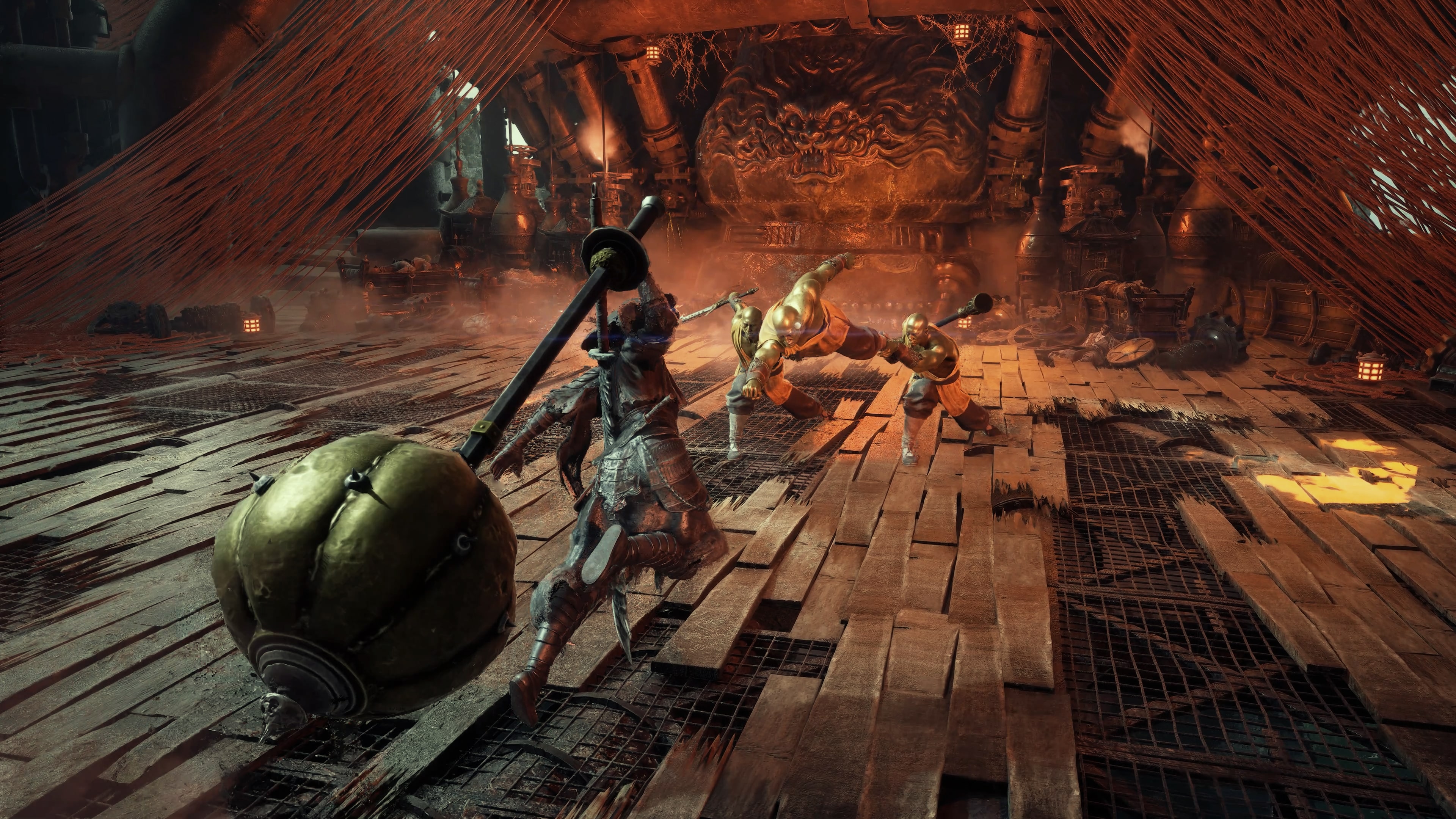
Official 4K screenshot from the Phantom Blade Zero page on the PlayStation Store: firelight, haze, and layered structures forming a complex lighting scene (source: S-GAME / PlayStation Store).
Enhanced is not the same thing as Game Boost
The Pro has a second performance mechanism called Game Boost, and the two are easy to conflate. Game Boost is a compatibility feature aimed at existing games: it can raise frame rates in some PS4 and PS5 titles with no work required from developers, Sony scopes it to "some" games, and it sits on top of a compatibility layer covering more than 8,500 PS4 titles. Enhanced support runs the other way — it is content the developer built specifically for this game, with the Pro's capabilities taken into account during development. Phantom Blade Zero has the latter.
The practical reason to keep them apart is the kind of gain each one produces. Game Boost produces frame rate. What Phantom Blade Zero gains on the Pro is not frame rate. Treat the two as interchangeable and you end up expecting a Pro purchase to make the same game run faster, which on this title is not what happens.
Two limits on this audit
First, the basis is secondhand. Digital Foundry's analysis reached us through write-ups at TwistedVoxel and PSU; the original video was not reviewed directly for this article. The upscaling conclusion is tentative in both, and the claim that the toggle enables hardware Lumen is the analysis's judgement rather than an official statement. The verdicts above are drawn from the measured figures those write-ups report.
Second, the Pro-side resolution data is missing. The write-ups we read give internal resolutions for the base console's three modes but not for each mode on the Pro. "Sharper on the Pro" is therefore an observation, not a pixel count, and the two should not be substituted for each other when quoted.
The PC side is a different set of variables. The day-one patch claims improved ray tracing and path tracing performance, and which driver to run there is covered in our day-one patch and driver notes, with the install size threshold in preload and file size and GPU tiers in our PC requirements comparison.
On a Pro, start from performance mode and feel free to turn ray tracing on — it costs very little in frame rate, the reflection and global illumination improvements are visible, and edges are cleaner in motion. On either machine, balanced mode is not the first choice, and the reason has nothing to do with hardware: it is frame pacing. The mode-by-mode trade-offs are set out in our mode comparison.
If the console purchase is still undecided, this badge is not an argument that you must have a Pro. What it delivers is image quality, not smoothness, and the setting this game is recommended to run at — 60fps performance mode — exists on both machines. The full path from the original September 9 date to the October 29 launch is in our delay record.
This article draws on the PlayStation Store listing and Sony's PS5 Pro pages for the badge definition, and on Digital Foundry's technical analysis as reported by TwistedVoxel and PSU. Resolutions and frame rates are observations from that analysis, and later patches may change actual performance.