Digital Foundry published its technical analysis of Phantom Blade Zero on PS5 and PS5 Pro on launch day, 29 October. The conclusion is unusually direct: performance mode is the first choice on both consoles, because combat benefits from the extra responsiveness and the gap between the modes is not wide enough to justify giving up 60fps. The weakest link is the 40fps Balanced mode, whose frame pacing stays broken even with variable refresh rate enabled.
The base PS5 offers three modes: Performance targeting 60fps, Balanced targeting 40fps, and Graphics targeting 30fps. The PS5 Pro keeps the same three and adds a ray tracing toggle on top. Most of what separates the modes comes down to shadow quality and internal resolution; what separates a good experience from a bad one is the shape of the frame rate curve.
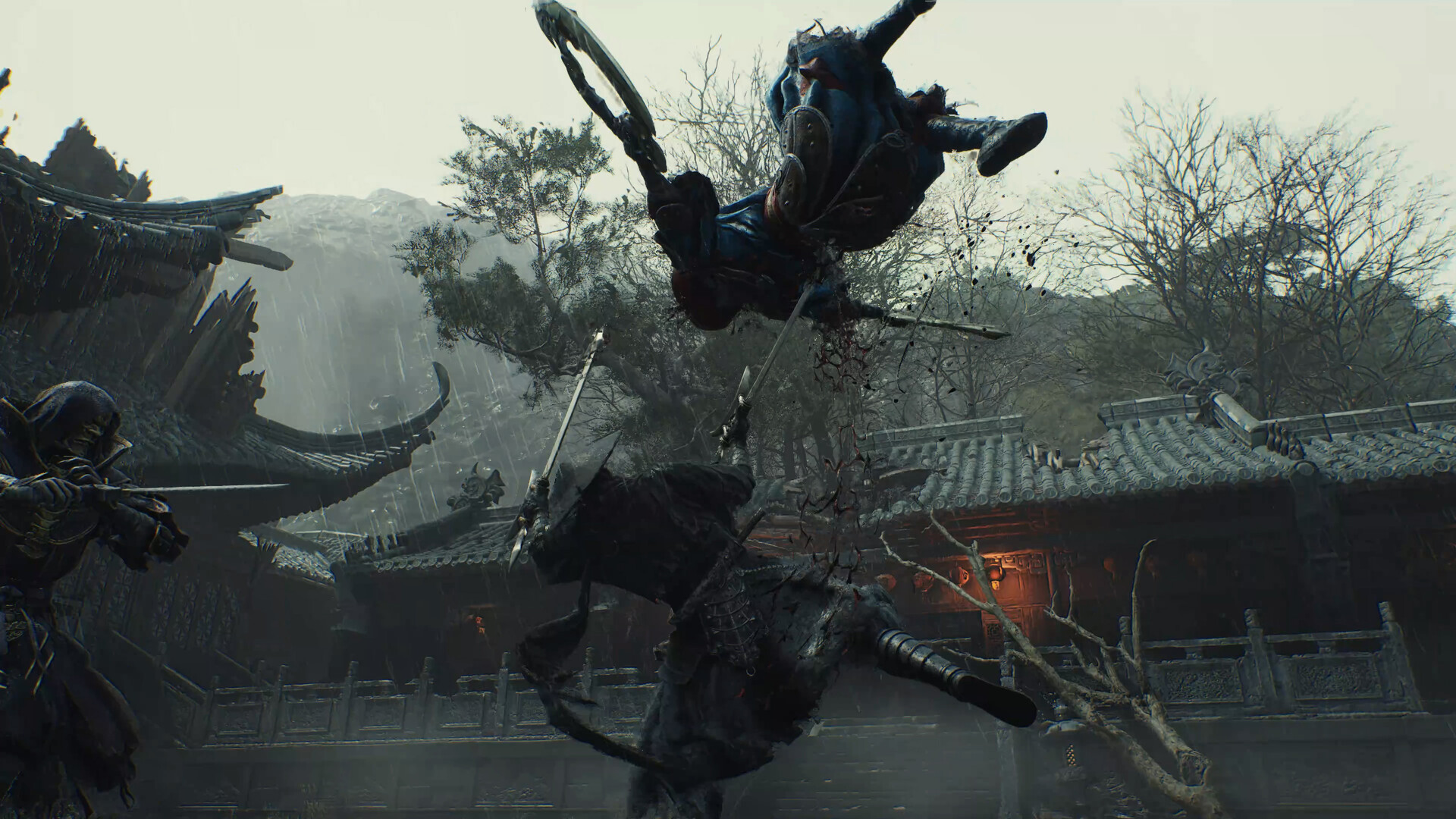
What each mode actually renders
| Mode | Frame rate target | Internal resolution (dynamic) | Main visual difference |
|---|---|---|---|
| Performance | 60fps | roughly 900p-1080p | Lower shadow quality |
| Balanced | 40fps, delivered over a 120Hz output | between the other two, closer to Performance | Mid-level shadows |
| Graphics | 30fps | around 1440p | Noticeably better shadows |
Those resolution figures are internal, not output. The game runs dynamic resolution scaling with TSR temporal reconstruction, so the pixel count moves during play: heavier scenes with more light sources and enemies drift toward 900p, calmer ones can sit closer to 1080p. The roughly 1440p figure for Graphics mode is the same kind of range, not a fixed number.
Digital Foundry's assessment is that the most tangible visual difference between the three modes is shadow quality, with Graphics mode clearly ahead, and that the remaining differences are limited. According to TwistedVoxel's summary of the analysis, Graphics mode also held 30fps in general, so that mode delivers on both halves of its pitch.
What those numbers mean once the image is reconstructed
A 900p internal render does not reach the screen as 900p, which is why the mode can look closer to graphics mode than the raw figures suggest. Dynamic resolution scaling lets the engine trade pixels for frame time scene by scene, and TSR then rebuilds a full-resolution image from the current frame plus data carried over from previous ones. The cost of that approach shows up in motion: when the camera swings quickly or a blade cuts across the screen, the reconstruction has less reliable history to draw on, and fine detail smears.
That is also the clearest way to read the PS5 Pro result. If the Pro really does swap TSR for PSSR, the practical difference should appear exactly where TSR struggles, in fast movement, and it should be most visible in the mode with the lowest internal resolution. Digital Foundry's finding that the sharper image is most obvious in performance mode matches that expectation.
Performance mode holds 60fps, and the drops are brief
On the base PS5, performance mode maintains 60fps through normal play. The drops Digital Foundry recorded were brief and sporadic rather than sustained, and the frame rate held up well in the busiest combat encounters. For an action game built around precise parries and dodges, that stability matters more than a higher pixel count.
The engine underneath is Unreal Engine 5, using both Nanite and Lumen. The analysis singles out how the environment reacts to the player: foliage moves in response to movement and sword strikes, and hair and clothing animate dynamically through fights. All of that costs frame time, which is exactly why holding 60fps under this load is the reason performance mode gets the recommendation. Eurogamer Portugal's summary adds a useful frame of reference: the combat tempo sits closer to Devil May Cry's fast action than to a measured Souls-like rhythm, and that is a kind of game where frame stability weighs directly on how trustworthy the controls feel.
The 40fps Balanced mode: the frame rate is fine, the pacing is not
Balanced mode targets 40fps delivered over a 120Hz output. It is the compromise tier that has become common on consoles over the past few years: smoother than 30fps, cheaper than 60fps.
Forty is not an arbitrary number here. A 120Hz display refreshes 120 times a second, and 40 divides into 120 exactly three times, so every frame can be held for three refresh cycles without a cadence mismatch. That is why this kind of mode is described as 40fps over a 120Hz output rather than as a plain 40Hz signal.
The three targets are easier to compare as intervals than as frame rates: 60fps means a new frame roughly every 16.7ms, 40fps every 25ms, 30fps every 33.3ms. On paper that places 40fps where the tier is supposed to sit, close enough to 60 to feel responsive while costing noticeably less than a full 60fps budget. The arithmetic assumes steady intervals, which is precisely what this mode does not deliver.
Digital Foundry's verdict on this mode is harsh, describing its frame pacing as "totally busted". Frame rate and frame pacing are different measurements. An average of 40fps says how many frames were drawn in a second; frame pacing says whether the gaps between those frames were even. When the gaps stretch and compress, the image reads as choppier than the frame counter suggests, and the unevenness does not show up in a frame rate reading at all. According to TwistedVoxel's summary, that is exactly where this mode falls down, and the theoretical advantage never reaches the screen.
The more important detail is that enabling variable refresh rate in the console settings did not resolve it. VRR compensates for a mismatch between display refresh and frame delivery, but it assumes the delivery itself is regular. When the intervals are the thing that is wobbling, variable refresh rate has nothing to lock onto. On the available summaries, this is the one clear defect in the package that needs a patch from the studio.
PS5 Pro: an extra ray tracing toggle and a sharper image
The PS5 Pro keeps all three modes and adds a ray tracing toggle covering shadows, reflections and global illumination. According to TwistedVoxel's summary, Digital Foundry believes the toggle enables hardware Lumen: reflections pick up clearer geometric detail and global illumination improves slightly, while shadows show no meaningful change.
The Pro's other gain is in how the image is assembled. The analysis attributes the sharper result to Sony's PSSR upscaling standing in for the TSR used on the base console, with the difference most visible in motion and most pronounced in performance mode. That lines up with the PS5 Pro Enhanced label on the PlayStation Store, which promised ray tracing, PSSR and more stable frame rates; the analysis now fills in the specifics for this game.
Calling the toggle hardware Lumen is a meaningful qualifier rather than jargon. This is how Lumen's two paths generally work, not a claim Digital Foundry makes in the analysis: the software path computes global illumination on the GPU's general-purpose units, while the hardware path leans on dedicated ray tracing units for the same job. The hardware route is the one that can add the reflection detail described above at a small frame cost. What it does not do, according to the same analysis, is fix shadows.
Frame rates on the Pro are broadly in line with the base console. Performance mode still spends most of its time at 60fps, Graphics mode still targets 30fps, and the Balanced mode carries over the identical frame pacing problem. Turning on the extra ray tracing features has little impact on performance, which is itself part of the finding: the Pro's advantage lands on image clarity and lighting quality rather than on smoothness.
Choosing a mode on either console
On the base PS5, performance mode is the default answer. Even if shadows are the one clear gain in Graphics mode, that gain is not worth the responsiveness lost at 30fps unless shadow quality is specifically what matters and the slower feel is acceptable.
On the PS5 Pro, start from performance mode again and turn the ray tracing toggle on: the cost is small and the reflection and global illumination improvements are visible. A cleaner edge in motion is precisely the part of the package that PSSR contributes.
Balanced mode is not a sensible first pick on either machine, and the reason has nothing to do with which console is under the television. It is also the one mode that assumes a 120Hz output, which raises the bar for the display compared with the other two.
The PC version introduces a different set of variables. The day one patch claims improvements to ray tracing and path tracing performance; the PC-side settings are covered in the day one patch and driver notes, and the install footprint is broken down in preload and file size.
Two caveats in the analysis
According to PPE's summary, the analysis notes two reservations: shadow generation still has limits, and some objects and characters are not always lit perfectly. The overall presentation still sits at a very high level.
It is also worth being precise about the boundaries of the analysis. The figures quoted here describe the three modes on the base console; the summaries available do not give separate resolution numbers for each PS5 Pro mode, so the Pro's sharper image is reported as an observation rather than as a measured pixel count. The analysis covers the console versions only, and nothing in it speaks to how the PC build performs on equivalent hardware.
Digital Foundry's conclusion comes down to a choice rather than a ranking: on both PS5 and PS5 Pro, performance mode is the first option, the combat benefits significantly from the improved responsiveness, and players are not missing out on any meaningful visual features.
This article is based on Digital Foundry's technical analysis of Phantom Blade Zero on PS5 and PS5 Pro, together with summaries published by TwistedVoxel, Eurogamer Portugal and PPE. Resolution and frame rate figures are observations from that analysis and may change with later patches.