With two weeks left before Phantom Blade Zero launches on October 29, S-Game opened a new round of press access at its Beijing studio. Alongside extended hands-on time, the studio made its leads available for interviews: creative director Soulframe Liang spoke to PCGamesN, composer Caisheng Bo sat down with the same outlet during the same trip, Japanese outlet 4Gamer ran a group interview with the director, and Inven Global's conversation focused on the team itself.
The interviews are mostly about how the game was built rather than what it plays like: how PlayStation first saw it, what the studio's starting conditions were, how large the content actually is, and why the soundtrack came to exist before the bosses it accompanies. They also land immediately after the hands-on wave: press played the game in Beijing and published previews first, and the development conversations followed within the same week.
The meeting: walking into PlayStation's boardroom with a rough prototype
In his PCGamesN interview, Liang recounted how S-Game, a studio founded in 2011 that had previously worked on smaller games and mobile titles, ended up attached to PlayStation. The team prepared an early build and went to a PlayStation office for what was meant to be a routine showcase meeting.
"We were two guys, very young guys with fresh faces, and we just walked into the executive conference of PlayStation," Liang said. "We just met a business guy. We showed him this mockup, a very rough mockup compared to what you see now. So that guy was impressed."
The meeting did not end there. Christian Svensson and Shuhei Yoshida were, in Liang's words, "beside our table" along with the rest of the senior staff, and the business contact called them over to watch the trailer. Svensson's reaction, as Liang recalls it, was blunt: "Holy shit! Who are you? This is so impressive." The studio, until then largely unknown, was invited to join PlayStation's 2023 showcase.
That left only two months to prepare. Liang called the 2023 showcase one of the strongest events in recent years, with Insomniac's Marvel's Spider-Man 2 among the games on show; for S-Game it was also the first time the studio had been part of an event at that scale, and the way its game reached the world stage came as a surprise.
Liang said the team had no time to build anything new, so it compiled and polished what it already had into a three-minute trailer, expecting little more than leaving "some kind of impression." The trailer instead became the second most-viewed reveal of that showcase, behind only Insomniac's Marvel's Spider-Man 2. Three years later, the game had its own dedicated State of Play. According to eXputer, S-Game's shareholders include Tencent, which holds roughly a quarter of the studio.
From an RPG Maker indie game to a first Unreal Engine 5 project
Inven Global's interview dealt with the conditions the team worked under. Building an action game in Unreal Engine 5 was a first for S-Game; in the years when development began, almost nobody in China had experience shipping a self-developed AAA project, so the pipeline had to be assembled from scratch in partnership with local outsourcing studios that had previously worked on Western and Japanese projects.
"Everything was new, and we had to find unconventional solutions to make what we wanted," Liang said. "We also hired very young developers. The most important tasks — for example, creating the final boss, or the opening sequence — we handed to people who had just graduated and had no experience with a project of that scale."
Even so, Liang describes the game as independent in spirit. "Some people ask whether Phantom Blade Zero is an indie game. Judged purely by scale, it is hard to call it that — it has a fairly large budget," he said. "But in spirit I consider it independent, because we try to keep the mentality of explorers: willing to take on extreme challenges and not afraid to go beyond the usual standards." The series itself traces back to Rainblood, an indie RPG Maker game Liang made as a student.
Scale: at least 50 bosses and more than 30 primary weapons
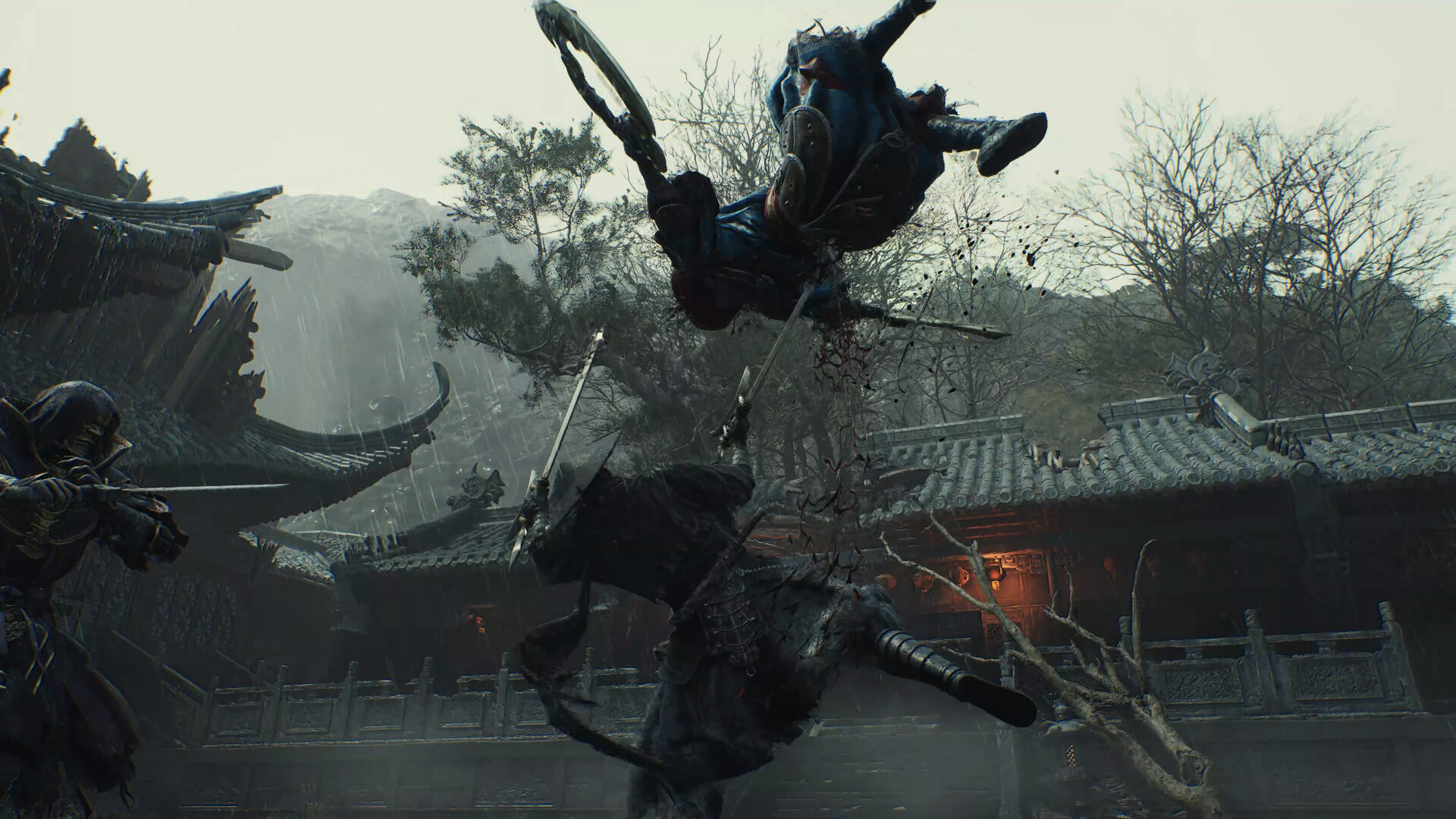
The group interview 4Gamer conducted with the director produced the most concrete scale figures so far. Liang said the number of bosses matches the number of weapons, since defeating a boss is how its weapon is acquired, and therefore "there are at least 50 of them, and in reality, there might be even more." He also broke down the arsenal: more than 30 primary weapons, plus around 20 secondary ones, all earned by beating bosses.
Enemy variety was stressed in the same conversation. Liang said enemies "create differences in their strategies and physique," ranging from large opponents to small ones, with shielded and mounted enemies among them, and that variety keeps increasing the deeper a player gets. The figures come from the 4Gamer group interview and were subsequently relayed by outlets including Tech4Gamers, GamingBolt, and PlayGround, which makes it the most complete account of the game's scale outside the studio's own materials.
The numbers give a usable sense of scale before launch: this is not a game planning to carry its runtime on a handful of showpiece fights. The same conclusion runs through the October 2026 media previews, where several writers noted that boss encounters are notably dense compared with similar games — partly because the total number is simply large.
Why the weapons don't have to be 100% balanced
A second PCGamesN interview addressed how those 30-plus weapons are tuned. Liang readily admitted the difficulty: "It's hard, especially for 30 different weapons. But the good thing is our game is a single-player game, and we don't have to make everything 100% balanced, so there are stronger ones and weaker ones."
His role for those weapons is closer to that of a set of keys. "Weapons are the key to solving the problem," he said. "So when you encounter some bosses and when you encounter some even minor different enemies, like the shield guy — the shield guy is a little problem, and you will resolve that with the axe or with the big flower blade. So in the whole process, we keep on giving players different problems to be resolved, and sometimes these problems require certain weapons or some certain builds to resolve them."
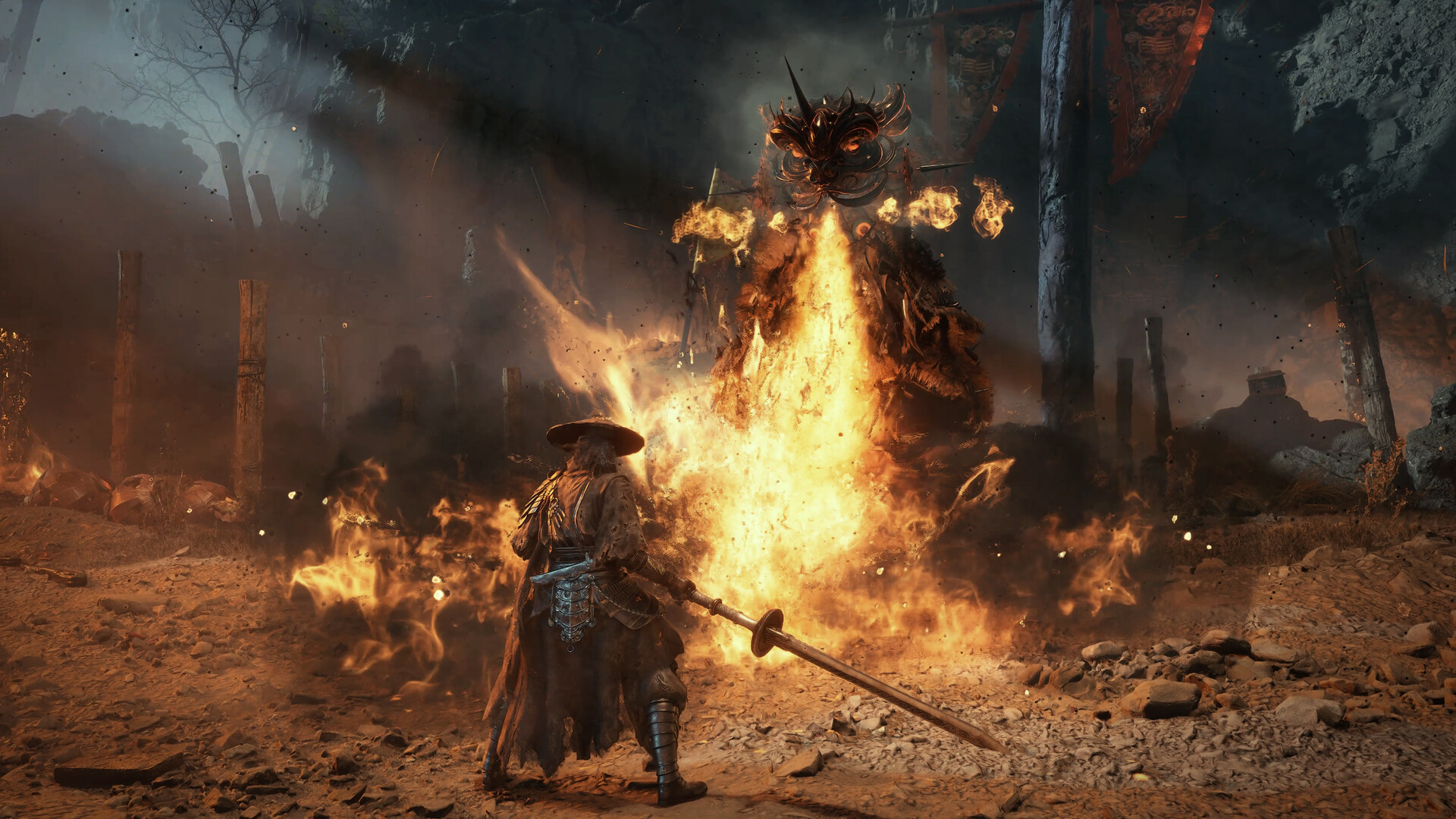
That rules out carrying one comfortable weapon through the whole campaign. PCGamesN's example is the boss from the recent trailer who wears a fire-breathing dragon mask and fights with a line dance: its health can be chipped away with anything in the arsenal, but bringing the weapon that blunts its main attack makes the fight considerably easier. The game does not point players toward the right equipment, leaving that read to them.
Liang framed that intent as a design goal rather than a side effect of hard balancing. "We hope people explore as much as possible and use different weapons to beat the boss," he said. Because a weapon changes both the damage a character deals and how they move, the system pushes players toward experimenting instead of settling on one favourite and never swapping again.
There is a deliberate schedule behind that arsenal as well. S-Game has been specific about how and when each weapon unlocks, and more outlandish ones are still to be revealed. Those weapons are not reskins of one another either; they change the damage a character can deal and the movement available to them, rather than swapping one model for another.
Writing the music before the bosses existed
The final round of interviews came from composer Caisheng Bo, who met Liang while the two were studying at college in the United States. That long-standing trust let the soundtrack enter development in an unusual order.
"The music is very important. Unlike other games, music isn't an afterthought," Bo said. "You have to finish the game first, or at least you have to reach a certain point, and then you find a musician to compose for the game. But for Phantom Blade, it's completely different. Like I, for some boss fights, I composed the music first."
That produced exchanges such as Liang responding to a finished piece with "Okay, this sounds good. Yeah, let me create a boss to match your music." When Bo was asked to compose for the line dance boss back in 2023, he asked whether any art design existed. The answer he got was that there was nothing yet — he was told to write something first and to serve as the inspiration. He did, though that particular piece was never used; it was, as he put it, too early.
Bo's stated direction for the score is to blend traditional Chinese instruments with what he called the modern side of China. He is a fan of rock, metal, and electronic dance music, and wanted all of that folded in with Chinese instruments. He was direct with the musicians performing it, too: traditional players are trained to perform pieces written hundreds of years ago, and he told them he wanted to do something new.
Bo traced the approach back to the studio's history. "Since we've started as an indie game developer, we're used to that kind of workflow," he said — writing the music first and letting the art follow is a habit small teams keep.
The score is not treated as background either. PCGamesN notes that across a boss fight the music moves through three different stages of the encounter rather than looping a single theme. That approach rests on familiarity: Liang knows the kind of music Bo likes to write, and was confident it would fit the vision he had for the game.
Not every piece of music made it into the game. Early on, players can meet an optional boss who is a bride, and the music Bo originally wrote for that encounter was judged offensive by some members of the team, so he rewrote it. Rather than discarding the first version, he placed it inside the in-game music player included with the deluxe edition. The deluxe edition also carries a jazz piece performed on traditional Chinese instruments that Bo describes as sounding genuinely strange.