Soul casting (铸魂) is the second progression track for main weapons in Phantom Blade Zero, and it is not the same thing as upgrading. It unlocks only once the main story reaches Pangzhen. Each cast costs one weapon-specific material plus 5,000 Remnant Dust, works exactly once per weapon, and does not give the material back. The hard part is never the dust — it is the materials, which sit behind side quests, hidden bosses and secret chests rather than on the main road, and several of which stop being obtainable once you push the story forward.
What follows splits into three layers: the rules, what a weapon turns into after casting, and where the materials actually are. The ribbon, tassel and cauldron-shard locations come from Chinese guide-site inventories compiled from Gamersky's regional soul-casting material walkthroughs; the rules and the 25-versus-24 weapon count come from a Xiaoheihe community compilation published on November 25. Each is attributed where it appears.
A note on names: this article gives descriptive English labels for places, weapons and items, with the Chinese original in brackets so you can match them against the in-game text. None of these English labels is a confirmed official translation of a proper noun.
When soul casting unlocks, and who to talk to
The unlock point is Pangzhen, not the starting area and not your first bell. Once the main story reaches Pangzhen, head to the Huangui Tavern (幻鬼酒馆) and talk to Huangui (幻鬼); the soul-casting option opens along that conversation line. The Chinese regional walkthrough for Pangzhen opens by stating the same thing — that weapon soul casting is unlocked in Pangzhen — which is consistent with the tavern's position in the story.
Before that conversation, having a material in your bag and the matching weapon in your inventory is not enough. This is worth saying first because the material itself tells you nothing: it sits in your inventory as an ordinary item, it does not appear in a dedicated slot, and picking it up triggers no explanation.
The Chinese regional walkthrough puts soul casting as the key to a weapon's exclusive advanced effect rather than a plain attack boost. It opens a layer that only that specific weapon has. Swap to another weapon and neither the progress nor the effect carries over.
Four rules: one cast per weapon
| Item | Rule |
|---|---|
| Which weapons | 25 main weapons, of which the wooden Hei Shang (木制黑伤) cannot be cast; the other 24 can |
| Cost per cast | 1 weapon-specific material + 5,000 Remnant Dust |
| Uses | Exactly one cast per weapon |
| Material | Consumed and not returned |
| Result | The weapon gains its exclusive advanced effect, and its name may change |
The combination that hurts is the third and fourth rows together. You cannot cast one weapon "just to see what happens". Materials map one-to-one onto weapons, so a single material cannot be spent on a second weapon, and almost every material sits on a one-time node — spend it and it is gone.
The 25-weapon and 24-castable counts are from the Xiaoheihe compilation by dream36999 published on November 25. The official store description phrases the main-weapon roster as "over 30", a different counting basis; this article uses the former for the specific numbers and does not merge the two.
After casting, the weapon changes its name
The rename is real, and it is the reason players fail to match materials to weapons while browsing a list. The most frequently cited example: Hei Shang (黑伤) becomes Hei Mo Shang (黑魔伤) after casting.
Three masks currently have a documented pairing, each locking one weapon:
| Material | Casts into |
|---|---|
| Anmo Tianbao Mask (暗魔天堡面具) | Hei Shang → Hei Mo Shang |
| Langjun's Jade Face (郎君的玉面) | Yu Shuang Huan (玉双环) |
| Tiesha Mask (铁杀面具) | Cangang Ren (残钢刃) |
In the Xiaoheihe list the Anmo Tianbao Mask is entry one, filed after completing the five Long Pillar trials of Bloodline Awakening, and it matches the mask-usage table on the Chinese guide sites: both point at Hei Shang becoming Hei Mo Shang.
That same mask inventory also lists Zhuobi's Shield (拙壁盾) alongside the three masks as a soul-casting material, without naming the weapon it belongs to. Items with a material role but no documented target are common enough in this system: an unfamiliar shield, mask or trinket is worth keeping rather than selling as clutter.
Pangzhen: five ribbons, all above eye level
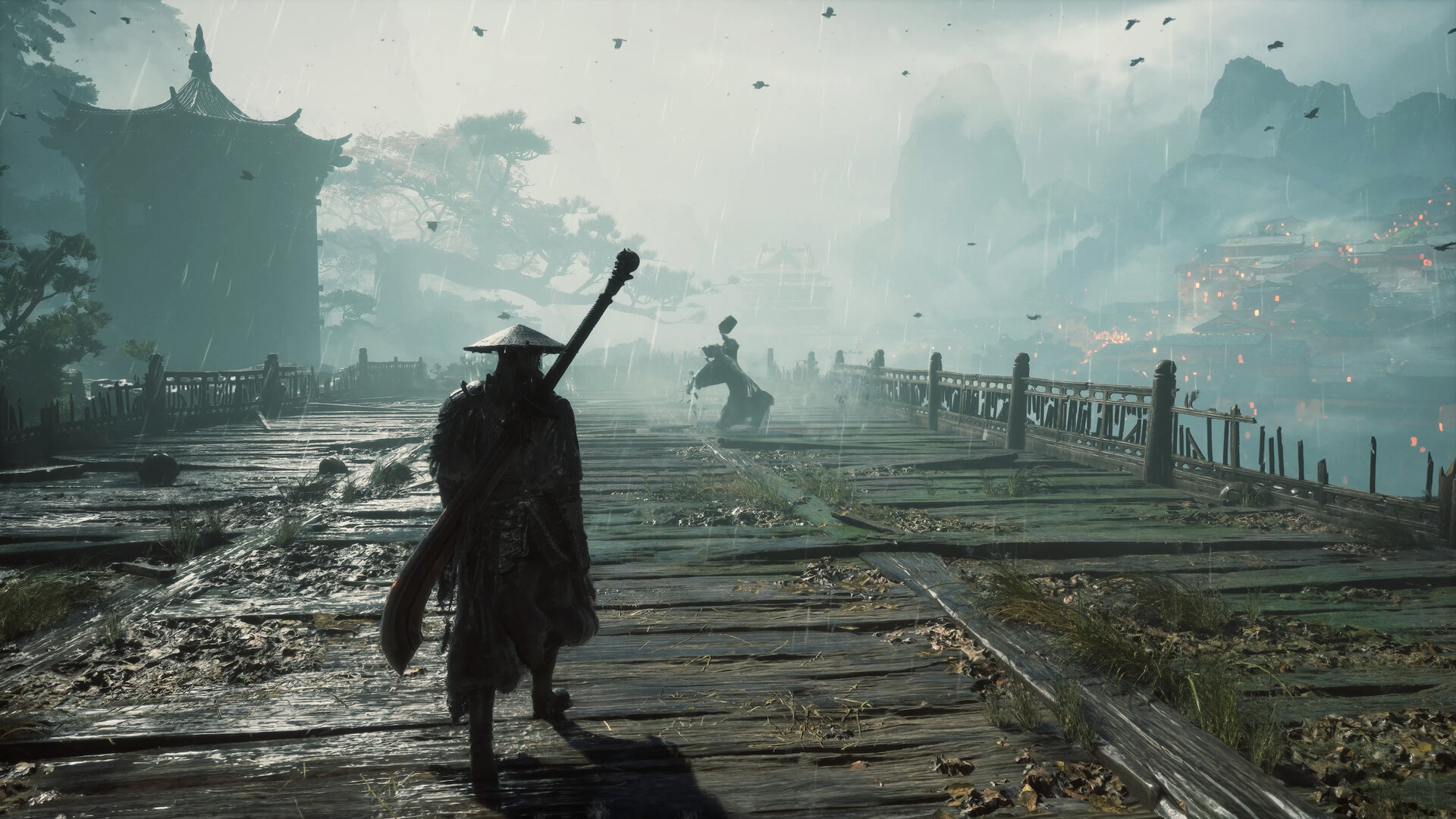
Pangzhen's soul-casting materials are a set of five ribbons spread across five nodes in the region. What they share is placement: every one is either above eye level or tucked around a corner.
- Ribbon one: after beating the gatekeeper boss Zhuobi (守门人拙壁), walk through the red-lantern gate directly ahead; the ribbon hangs on the large tree to the right of the wooden bridge.
- Ribbon two: at the bell of the Blue Firefly Temple (幽蓝萤火之庙), tied to the branches in front of the shrine.
- Ribbon three: from the Great Corridor Bridge (大廊桥) bell in Lujia Village, take the door on the right side of the building and follow the path down to the open area at the bottom. Walk to the shrine where the crowd kneels, cut the obstacle inside the red circle to reach the far side, and clear the enemies there; a new enemy climbs out of the coffin under the large tree. The coffin holds the second Black Stone Fragment and also releases the red threads blocking the Great Corridor Bridge. Return to the bridge, cross the section that was blocked, jump to the far side, and ribbon three is tied on the left.
- Ribbon four: from the Three Puppets Well (三人偶水井), follow the path to the Great Corridor Bridge, take the right-hand door and walk to the end, clear the bridge's red threads and cross into the next village. At the fork turn right and activate the bell called Before the Statue Yard (雕像场前), then step into the yard to trigger the fight against the crippled form of Sect Master Bi Yuan of the Tianxuan Sect. The fourth ribbon is tied to the bell that appears after the fight, the Holy Mother's Statue Yard (圣母雕像场).
- Ribbon five: push the Lujia Village main story first — beat Sect Master Bi (毕掌门) and Elder Bihai (碧海长老), then attack the crippled body grappling with the clockwork behemoth inside the house beside the behemoth's wreck (机关巨怪残骸). Return to the Three Puppets Well, drop down the well to activate the bell below, follow the path to the wooden bridge and pick the ribbon up on the right side.
Two of the five sit behind red threads, and those threads only come down after clearing the village across the Great Corridor Bridge and the enemy in the coffin. If your route is "cross the bridge and keep going", those two are gone.
The Mandate Encampment: a sword tassel and a chainsaw
Two nodes are documented in the Mandate Encampment (正道大营): the Plain Sword Tassel (朴素的剑穗) and the Reinforced Chainsaw (强化电锯).
The tassel sits at the encampment's collectible spot. Cross the ridge ahead, enter the more open area, and it is beside a gravestone — not inside a building and not in a chest, which makes it an easy ground pickup to walk past.
The chainsaw is behind the waterfall. Start from the bell behind the encampment waterfall, follow the road downhill, enter the first building on the left and open the hidden room in its right wing. The door needs the Blood Dripper (血滴子); without it you can only look at the door.
Mountain of Imprisonment: repair the pipa, then gather three cauldron shards
The Mountain of Imprisonment (枷笼山) material is the Restored Cauldron (复原的宝鼎), and it works differently from the ribbons: it starts life as shards scattered around the region and only becomes a usable material once assembled.
Getting into the mountain at all has a prerequisite. The mist on the north side of Meigu Lake can only be cleared with the Illusory Pipa (幻术琵琶), and the pipa is the mid-section product of the Lake Heart Secret purple quest chain. How to assemble its three components and how to walk the Inanis Dreamscape portals is laid out in order in the Lake Heart Secret walkthrough; one line is enough here: if the mist will not clear, the problem is not the mountain.
There are three shard nodes, two of them behind the Blood Dripper:
- One shard is on the Path of the Holy Mother (祭拜圣母之路). From the bell, follow the road ahead and then take the left-hand path down; open the hidden passage with the Blood Dripper and the shard waits at the end.
- Cauldron Shard Two (宝鼎碎片·之二) is on Cage Road (囚笼道). From the bell, take the road behind you down, open the hidden passage with the Blood Dripper, and it is on the table.
- Cauldron Shard Three (宝鼎碎片·之三) is not in a chest. After beating Hengdao Bi Feng (横刀:毕峰), return to the Jianghu figure to collect it.
With all three in hand the cauldron is restored into a material. The trap here differs from Pangzhen's: the materials are not missed by walking past them, they are cut off by prerequisites — no pipa and you cannot enter, and once inside, no Blood Dripper means one shard per visit at best.
What can be missed, and the order to collect in
Put the regions side by side and the risk splits into three kinds.
The first is main-story node binding. Two of Pangzhen's five ribbons sit on one-time nodes — the Great Corridor Bridge threads and the crippled Sect Master at the Holy Mother's Statue Yard — and once the story crosses the bridge neither can be recovered. The Pangzhen walkthrough turns this into an explicit warning, and it is the single sentence worth remembering from this article: after the story advances, some materials can no longer be obtained. Clear the ribbons as soon as soul casting unlocks in Pangzhen, before moving on, and this category costs you nothing.
The second is long-quest binding. Some materials are not picked up at all, they are quest rewards. The Purple-Gold Flower (紫金之花) is the end product of the Lake Heart Secret chain and is used to cast the Phantom Edge Xukong Huashan (虚空华扇); the Young Lord (少主) side quest in Lujia Village hands over a soul-casting material called Quanxin Fragment: Core (拳心碎片·核) among its rewards, while the Quanxin quest in the Crimson Forest supplies the other half of the Iron Fist Gauntlet (铁拳套). These have no map deadline — their deadline is the quest log. Finish the purple quests before moving to the next big map, or the materials leave with them. Which purple quest has to close before which story point is listed by deadline in the trophy guide, and the two lists read well side by side.
The third is hidden rooms. The Mandate Encampment chainsaw and two of the Mountain of Imprisonment shards all sit behind doors the Blood Dripper opens. The game gives no visual prompt for these doors at all, so the habit has to be yours: any door that looks suspicious gets one Blood Dripper attempt.
One last point on priorities. Soul casting does not replace weapon upgrading. Upgrade levels, the level cap on weapons and Phantom Edges, and how the second playthrough lifts that cap from 30 to 35 are a separate system, covered in the New Game Plus carry-over list. Soul casting decides whether a given weapon has its exclusive layer; upgrading decides its base multiplier. You want both, but materials exist in single copies, so decide which weapon deserves the cast before you spend one.