Side quests carry more weight in Phantom Blade Zero than the phrase usually implies. In the game's dedicated State of Play deep dive from August 2026, S-Game laid out the loop plainly: as Soul travels the Wulin, he will meet residents who need help, and interacting with them and completing some of their side quests "might even open up new story paths." The same presentation added that secrets are hidden throughout the Wulin, waiting to be uncovered as you close in on the truth behind the events that set the story in motion. Both statements come from the official PlayStation Blog accompanying the showcase.
On their own, those are two lines of marketing copy. Set against the ending rules the director has already confirmed and the structure of the game's eight maps, they become something closer to a planning document: they tell you which detours are worth taking, which corners are worth revisiting, and where the risk of the bad ending actually lives. This piece assembles what official materials currently confirm about the side-quest layer, the hidden layer, and the exploration rules that connect them — ahead of the game's October 29, 2026 launch (October 28 in the US and selected regions).
Where this information comes from
The core source is the Phantom Blade Zero State of Play deep dive aired on August 17, 2026 (the morning of August 18 Beijing time) — a gameplay showcase of nearly twenty minutes, presented by director Soulframe Liang, that for the first time showed exploration, side-quest structure, and the secret layer in their finished context. The official PlayStation Blog post published alongside it pins down the key sentences quoted above.
Interviews fill in the rest. The keys-and-locks system and the weapon-upgrade economy come from Soulframe's conversation with RPG Site after The Game Awards in December 2025; the eight endings and the warning about the bad ending come from his GameRant interview in the same window. The three rules that shape exploration pacing — enemies that don't respawn, resources that stay with you after death, and fast travel between discovered bells — each have a combination of a direct statement from the director and hands-on reports from multiple outlets that played the game at trade shows. Every claim below points to its source.
Side quests: residents, new story paths, and the ending
Two concrete facts define the side-quest layer.
First, side quests come from the people on the road. The official framing treats the Wulin as a dark martial world rife with conflict and intrigue, where Soul meets citizens in need as he travels; talking to them and completing some of their requests deepens your understanding of this dangerous place. These are not notice-board chores detached from the world — the encounter with a person comes first, the task second.
Second, the most consequential sentence in the entire presentation: completing some side quests "might even open up new story paths." The wording is worth dwelling on, because it says paths, not rewards. The output of these quests is new story content itself — new routes through the narrative — rather than an accessory or a pile of currency. Compare that with how the director has described the game's structure since the media previews in late 2025: a clear main line with forks and side paths, including large-scale side quests. A meaningful share of those forks, it now appears, are opened by side content rather than by the main quest chain.
There is a third data point, and it is the one that turns planning into stakes. In his GameRant interview, Soulframe confirmed that Phantom Blade Zero has eight endings and delivered the line that has been quoted ever since: players who rush the main story and do almost no side quests "may end up with the bad ending." Read together with the new-story-paths confirmation, the conclusion is fairly clear: at least one route toward a good ending is paved by side quests. If you want the full picture of the ending system, including how the eight endings are reached and what separates them, the site has a dedicated breakdown: Phantom Blade Zero's 8 endings and playtime, explained.
Just as important is what has not been announced. The total number of side quests is unknown. Which quests belong to the "some side quests" that open story paths is unknown. What those new paths contain — a full alternate arc, a shorter branch, a different final act — is unknown. And no trigger deadlines have been published for any quest. The studio mentioned large-scale side quests during December 2025 media sessions, but the size and count of individual quests can only be verified when the game ships on October 29.
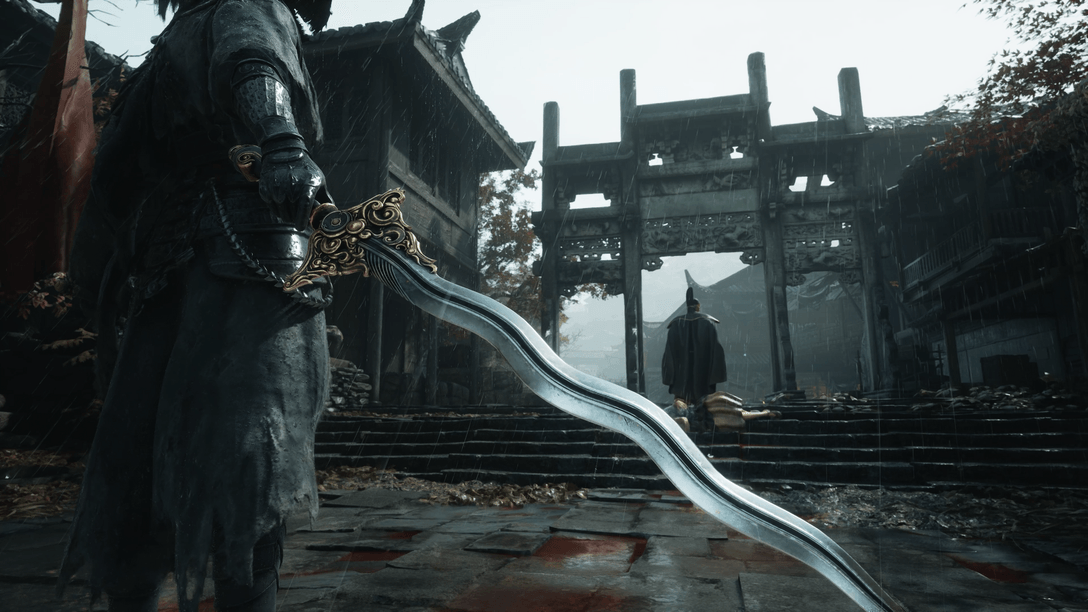
Official Phantom Blade Zero screenshot from the August 2026 State of Play deep dive. Encounters on the road are not always enemies — the people Soul meets, and the requests they make, are where the side-quest layer begins.
The hidden layer: three tiers of secrets
"Secrets are hidden throughout the Wulin" is the official line, and the confirmed material suggests that this secret layer has at least three tiers.
Hidden enemies and the hidden boss at the top
The State of Play materials list what exploration pays out: hidden enemies, side quests, rare treasures, and major story clues. The hidden-enemy tier connects directly to combat, because the official blog also confirms that defeating certain enemies expands your arsenal — which makes hidden strong enemies one of the game's weapon sources, not just an optional challenge.
At the top of this tier stands the one name the studio has put on record: Mo Yuan. The director has confirmed he is a "powerful hidden boss," encountered only after working through a series of explorations and trials, and he remains the only hidden boss officially named for the full game. His identity, his place in Soul's family history, and Donnie Yen's performance are covered in the dedicated profile: Who is Mo Yuan in Phantom Blade Zero?. For exploration purposes, one conclusion matters: hidden encounters in this game form a layer, Mo Yuan is the ceiling of that layer, and he is very likely not the whole of it.
Trade-show demos have already demonstrated how this design behaves in practice. At Gamescom 2025, the booth team told visitors the demo contained a hidden boss you had to search for — and that you could ask the staff for a hint if you couldn't find it. Gamereactor booth interview The same demo included a boss you were allowed to skip: Red Wraith, a fast female opponent. Skip her, and she later joins the second phase of another boss fight, the Chief Disciple's, making that encounter substantially harder. The demo build is not the final game, but the design intent is legible: skipping things has consequences.
Collectibles and story clues in the scenery
The remaining items on the official list sit at the reward end of exploration. Hands-on reports describe the texture of it: collectibles scattered across each area, some of them incrementally raising health and power; background documents that flesh out the world's history between missions. In other words, exploration pays out along two tracks at once — one numeric, one narrative. The narrative track is the one that matches the official phrasing about uncovering "the truth behind the events that set the story in motion": this mystery is not told only in main-story cutscenes. It is also buried in the corners of the Wulin.
Rare treasures connect to the build system as well. Every main weapon and secondary weapon has its own upgrade system, and some also have evolution systems that unlock new skills and movements; the items that fuel those upgrades are collected across the game, and Soul has a skill tree of his own on top. The weapon systems and how to combine them are covered in detail elsewhere: Phantom Blade Zero weapons and difficulty, explained. The official blog adds two extensions to the build itself: weapons can be paired with different accessories to shape your setup, and summons can fight alongside you or take enemies down from a distance. For exploration, the takeaway is the same as for the story: the materials you need are not in a shop. They are on the road.
Keys and locks: a layer built for the trip back
The director has described roughly ten different "keys and locks" in the game, with secondary weapons doubling as the keys: fragile ground that only a hammer can break, for example. The pointed part of his example is the timing — the moment you first find the hammer, you have usually already walked past the fragile floor. The system is built so you can go back for the secret underneath. This layer only works because of the world's shape: eight seamlessly connected, hand-drawn maps form one continuous landmass, so the key found in the final map still opens the lock you left behind in the first one. The full structure — how the eight maps connect and how the Pang Town hub works — is covered in Is Phantom Blade Zero open world?.
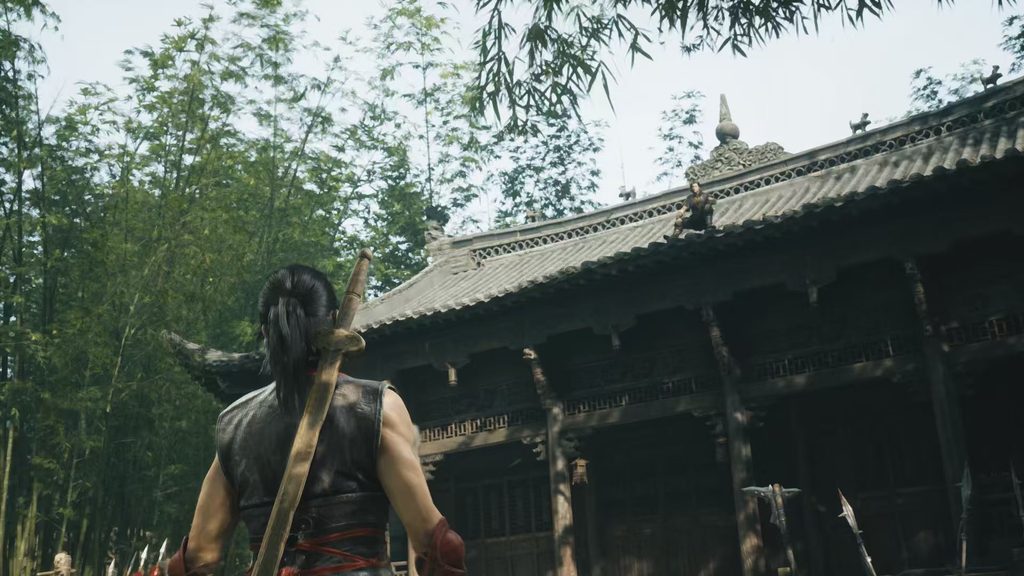
Official Phantom Blade Zero screenshot. Who the figure on the roof is, the frame does not say. Corners like this one, off the main road, are exactly where the officially confirmed secret layer lives.
Three rules that make exploration cheap
Exploration in Phantom Blade Zero runs on three confirmed rules, and together they push the cost of detours close to zero.
Cleared areas stay cleared. When the director explains why the game is not a Soulslike, one of his standing examples is that enemies do not respawn after your deaths or checkpoint rests; hands-on reports from Insider Gaming and CGMagazine match that description. The practical consequence for exploration is that a swept area stays quiet. Going back for a key, a chest, or a side quest means walking real distance but not re-fighting the same patrol five times. Farming respawns for resources is a route this game deliberately does not offer.
Death does not confiscate your progress. In the previews, dying cost no collected currency, and dying in the second phase of a boss fight restarted that phase rather than the whole encounter. The penalty for a failed exploration run is the time it takes to walk back, not the contents of your pockets. One caveat belongs here: how the sixty-six-days premise operates mechanically, and whether deaths consume days of that countdown, has not been confirmed — preview coverage that suggested as much was openly guessing, and so this piece leaves it at the door.
The bell is map reveal, respawn point, and fast travel in one. Ringing a bell reveals part of the map, and bells double as both respawn points and fast travel nodes between discovered locations. Combined with the keys-and-locks layer, the loop keeps the repetition cost low: you re-walk the road, but you don't re-clear it.
All three rules were consistent across every preview that checked them, but they remain pre-launch observations; if anything shifts in the release build, official notes take precedence.
How it all fits together before October 29
Assemble the confirmed rules and the picture is this:
- The main story runs roughly 20–30 hours; the full game has eight endings.
- Completing some side quests may open entirely new story paths.
- Secrets hide across the Wulin: hidden enemies, rare treasures, story clues, and the hidden boss Mo Yuan.
- Every weapon and secondary weapon carries its own upgrade system, fed by materials found through exploration.
- Enemies don't respawn, death doesn't cost resources, and bells connect discovered locations.
Everything in that list points in one direction: Phantom Blade Zero hands the decision about which ending you see to your exploration completeness, and then prices the complete route low enough that a thorough playthrough is a scheduling problem, not a grind. A main-line-first route also exists — finish the story, take your ending, then use bells and keys to sweep back through the side quests and secrets. Mechanically that run is valid; the catch is that the bad ending you are most likely to hit lands inside your first playthrough, and it colors the whole run. The sixty-six-day frame sits over all of these choices, turning "what do I do first" into part of the story rather than a menu question. Beyond that, the honest answer is that the balance is best tuned with a controller in hand after October 29.
This article is compiled from the game's official State of Play showcase, the PlayStation Blog, the director's interviews, and multiple media hands-on reports; information is current as of September 2026. Details may adjust as launch approaches — the shipped game and official channels take precedence.
Related reading
- Is Phantom Blade Zero Open World? How the Eight Maps Actually Work
- Phantom Blade Zero Weapons and Difficulty: 55 Weapons, Four Difficulty Modes
- Phantom Blade Zero Playtime and 8 Endings: 20-30 Hour Campaign, How to Avoid the Bad Ending
- Who Is Mo Yuan in Phantom Blade Zero? Soul's Father, Donnie Yen's Hidden Boss