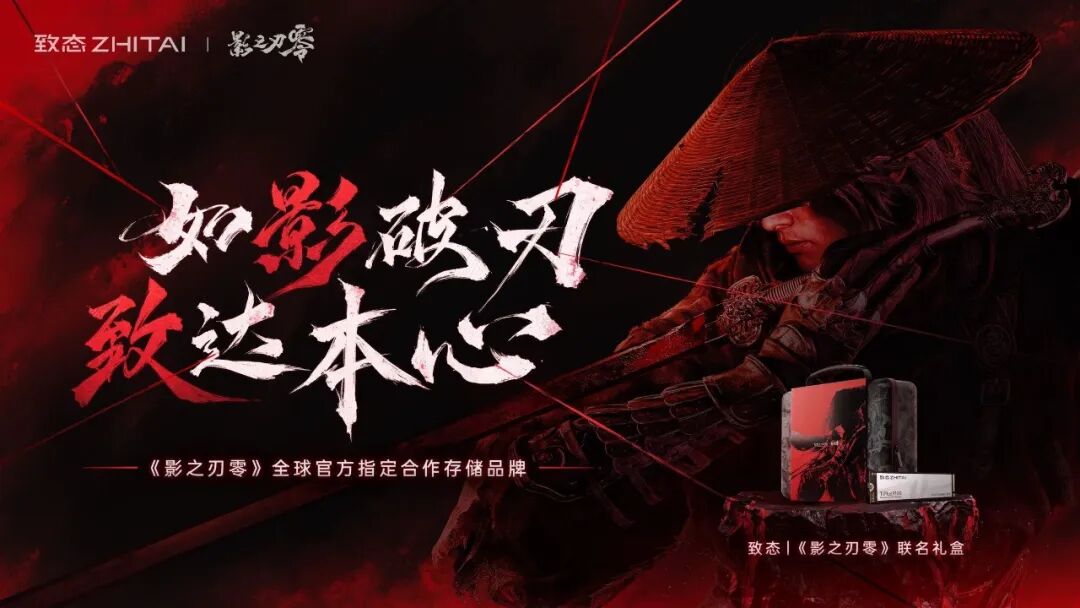
On October 24, ZHITAI, the retail storage brand owned by YMTC, announced a strategic partnership with Phantom Blade Zero and showed the first product from it: a ZHITAI | Phantom Blade Zero gift box. The box's release date is to be announced later, per IT Home's report that day. The official poster describes the brand as the game's "global officially designated storage partner."
The announcement lands in the final week before launch. Phantom Blade Zero unlocks on October 29, while the box is listed only as "coming later," with no stated relationship between the two dates.
What is in the box
The official contents list has five items:
- A ZHITAI TiPlus9100 SSD with a custom sleeve
- A custom storage case
- A custom "Hei Shang" screwdriver
- A custom crane-bell case sticker
- A lenticular poster
The five items divide into one working component and four extras. Two of the extras belong to the act of building rather than to display — the screwdriver is a tool, and the sticker goes on a case panel. The storage case is built around the drive and the tools that ship with it: the SSD arrives in its own sleeve, and the case holds that sleeve alongside the screwdriver, so the package works as a small kit rather than a display-only box. The screwdriver is the tool an M.2 install actually calls for — one screw holds the drive down at the far end of the slot. The case sticker takes a crane-and-bell motif, and the poster is a lenticular print, a sheet whose image shifts as the viewing angle changes.
The design brief was summarized in four words: enter, accompany, decorate, collect. The announcement does not map those words to individual items, though the order matches the way the contents are used: the drive is the piece that goes into a machine, and the case, sticker and poster follow as display items. Read against the contents list, the drive and its sleeve sit closest to use, while the case, sticker and poster read as display and collection pieces. That mapping is an interpretation of the list; only the four words are official.
Visually the box uses a dark wuxia palette of black and red, and the poster carries the line "如影破刃 致达本心" — a four-character couplet playing on the game's title. The materials follow the same visual language as the game's own campaign rather than introducing a separate design system.
TiPlus9100 specifications
The drive at the centre of the box is the TiPlus9100. The published figures:
| Item | Specification |
|---|---|
| Form factor | M.2 2280, single-sided PCB |
| NAND | Xtacking 4.0 TLC |
| Cache | DRAM-less, no dedicated DRAM cache |
| Interface | PCIe Gen5 |
| Sequential read | up to 12,000MB/s |
| Sequential write | up to 10,700MB/s |
What each of those means in practice:
M.2 2280 is the standard consumer SSD size, 22mm wide and 80mm long, which is what the M.2 slots on most motherboards and laptops are built for. A single-sided PCB, as the spec sheet puts it, is the layout in which only one face carries components; the usual benefit of that design is a thinner drive, which matters for slim laptops and for install positions where a thermal pad has to press flat against the drive.
TLC means three bits per cell, the mainstream choice for consumer drives. Xtacking 4.0 is the architecture name for this generation of NAND; Xtacking is the flash architecture associated with YMTC, the brand's parent company, and the 4.0 suffix marks the generation the announcement cites. DRAM-less means the drive carries no separate DRAM chip and relies on the host memory buffer to hold its mapping table. Removing that chip lowers cost and heat, and the usual trade-off is weaker random performance under sustained load compared with drives that keep dedicated cache.
PCIe Gen5 is the interface generation. PCIe 5.0 x4 offers roughly 14GB/s of theoretical bandwidth, so the rated 12,000MB/s sequential read sits close to that ceiling. For games, sequential throughput mainly affects loading and decompression of large files; frame rate depends on the GPU, the CPU and how the game streams its world, not on the drive's generation.
Fitting the drive into a machine
The TiPlus9100 is a standard M.2 2280 NVMe drive, the size current desktop boards and most gaming laptops are built for, so no adapter is involved. A 2280 slot puts the mounting standoff at the 80mm mark, which is the common layout on consumer boards.
The practical question is heat. PCIe 5.0 controllers run warmer than Gen4 parts under sustained writes, which is why most current motherboards cover their primary M.2 slot with a heatsink. Cooling is one of the main factors behind whether sustained transfers hold up, alongside workload and how full the drive is.
The announcement does not say whether the boxed drive ships with a heatsink of its own, and the custom sleeve is packaging rather than cooling. The extras also point at a PC build rather than a console: a case sticker, a screwdriver and a bare M.2 module, with no external enclosure in the list.
The install footprint it would sit next to
Capacity is the most practical number for a box like this, and the announcement does not state which capacity version of the TiPlus9100 is included.
The available figure comes from the game side. PlayStation Game Size, which tracks PS5 download sizes from PSN backend data, reported on October 16 that the PS5 build of Phantom Blade Zero weighs 134.857GB; Chinese outlets rounded it to 134.86GB. The PC install size has not been published.
On timing, the PS5 version opens preload on October 27 and unlocks at 10:00 Beijing time on October 29, per Chinese media checks of the store listing. Whether the gift box goes on sale inside that preload window is not something the announcement addresses.
Reading the key art
The official poster is a single dark composition: a figure in a wide-brimmed hat (douli) and dark armour, holding a weapon, stands on the right; red diagonal strokes cut across the background; the slogan sits in calligraphic type at the centre; the two brand marks are locked together in the upper left; and the gift box appears as a product shot at the lower right, printed with character art.
The slogan, 如影破刃 致达本心, is eight characters: 影 and 刃 come from the game's title, and 致 is folded in from the brand name — 致达 shares its first character with 致态. The caption under the product shot reads 致态 |《影之刃零》联名礼盒, the same product name used in the announcement.
Who ZHITAI is
ZHITAI is the retail storage brand of YMTC, the Chinese NAND manufacturer; the brand's job is to turn that flash into finished consumer products, and its line-up covers consumer SSDs and portable storage.
On paper the TiPlus9100 belongs to the PCIe 5.0 generation. Gen5 consumer drives began reaching the market after 2025 with sequential bandwidth as the headline feature, at the cost of higher heat and stricter cooling requirements from the motherboard — which is part of why single-sided, DRAM-less designs have become more common in this class.
Four things the announcement leaves open
With the confirmed details listed, the gaps are equally clear.
The first is price: neither the box nor the standalone drive has one. The second is capacity: the TiPlus9100 ships in several capacities and the box does not say which. The third is the release date, stated only as "later" with no month; whether the box lands before or after October 29 changes what it is for — storage for a machine that already has the game installed, or part of a build assembled around launch. The fourth is how it will be sold — whether the box is a standalone product, whether it is bundled with the game, and whether it is limited to the Chinese market are all unaddressed.
Capacity and price decide what the box is actually worth. Since the announcement names no capacity for the bundled drive, how many installs of a 134.86GB game would fit on it cannot be calculated either, and the release date decides whether the box arrives in time for a build. Sale channel matters for a different reason: the poster names ZHITAI as the game's global storage partner, while the announcement does not say which markets the box itself will reach, or whether the extras inside it ship outside China.
On the public information so far, the contents list and the drive model can be confirmed, while the value question cannot.
Where it sits in the collaboration line-up
ZHITAI is not the first hardware brand to sign on. On October 23, Lenovo's Legion division announced it had become an official partner, showing Phantom Blade Zero custom versions of the Legion Y9000P Ultimate and Y7000X laptops on its campaign page, both with a wuxia-themed lid; prices and availability were not announced with them.
Earlier collaborations have included controllers from GameSir and Flydigi, ROG PC hardware, Viture XR glasses and a Jicaosi Industrial apparel line. Storage is the newest link in that chain, and the box format — one working component plus custom extras — is a different shape from the earlier single-product collaborations.
What the earlier collaborations share is a direct link to how the game runs: a controller to how it plays, a GPU or laptop to how it looks, an SSD to how fast it loads and how much room it needs. The screwdriver and the case sticker pull the product back toward collectible territory, away from the one component that does the work.
Once price, capacity and the sale date are published, the box's position becomes clear: a collectible that happens to include a drive, or a drive that comes with extras.